White Grubs in Turf
Rick L. Brandenburg & Peter T. Hertl, Extension Entomologists
CAUTION This information
was developed for North Carolina and may not apply to other areas.
[General Information] [Life
History ] [Management] [Other
Resources]
White Grubs (COLEOPTERA: Scarabaeidae)
General Information
White grubs are turf pests found throughout North Carolina. It is not uncommon
to find 10 or more grubs per square foot feeding on grass roots. Heavily infested
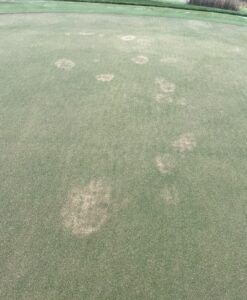
turf wilts or dies, often leaving the lawn feeling soft and spongy. Grubs may
feed for several months before any turf damage becomes visible. Severely damaged
turf may be rolled back like a carpet because its root system has been destroyed.
Bluegrass and bentgrass are the varieties most seriously attacked, but all grasses
are susceptible.
Because of their underground feeding habits, white grubs are more difficult
to detect and control than many of the pests that feed above ground. If they
are promptly detected and identified, they can be controlled through treatments
applied at the appropriate time. Outlined in this guide are proper scouting
procedures for detecting grub infestations and guidelines for timing insecticide
applications.
Description
White grubs are the larvae of scarab beetles. The grubs of economic importance
in North Carolina are those of the Japanese beetle, the green June beetle, the
southern masked chafer, the northern masked chafer, and the Asiatic garden beetle.
Several other species, such as May beetles and June beetles, are also present
but usually in low numbers. The Japanese beetle is consistently the most damaging
grub in this state. Two relatively new pests, the turfgrass ataenius (on bluegrass)
and the oriental beetle, are present in western North Carolina. These insects
appear to be expanding their range and may become serious problems in the near
future.
All these grubs have cream colored bodies with yellow to brownish heads, brownish
hind parts, and six legs. Mature grubs vary in length from 1/4 to 1-1/2 inches,
depending on the species. White grubs usually lie in a curled or C-shaped position.
Billbug larvae may also be present but can be
distinguished by the absence of legs.
Life History
All of the important species of white grubs in North Carolina have a one-year
life cycle and spend about 10 months of that cycle in the ground. The life
cycle of the Japanese beetle is typical for white grubs of importance in
North Carolina. Eggs are laid in late June and early July, and larvae hatch
out in July. These larvae feed on grass roots until cool weather arrives in
October. In November the grubs burrow deeper into the soil to over winter. The
grubs return to the root area and begin feeding in March. Larvae pupate and
adults emerge in May and early June. This life cycle is basically the same for
all species, although there is some variation in timing. There are three important
exceptions. Emergence and egg-laying for the oriental beetle is about three
weeks earlier than for the Japanese beetle, and emergence and egg-laying for
the green June beetle is about three weeks later. Timing of chemical applications
for these two species should be adjusted accordingly. The turfgrass ataenius
has two generations per year, overwintering as an adult and developing a second
generation of egg-laying adults by July. Therefore, this pest may require two
treatments.
Green June beetle
larvae are also differ in their feeding behavior. Instead of attacking grass
roots, these grubs feed mainly on decaying vegetation. Their burrowing smothers
grass and uproots seedlings. Sometimes in the fall or after a heavy rain green
June beetle larvae come out of the soil and crawl on their backs on the surface
of the ground. They can be identified by this unusual behavior and by distinct
spiracles, or dark spots, one per segment, on each side of the body.
Management
White grubs can be controlled in a timely and economical manner if proper controls
are correctly applied at the right time. To prevent serious damage, examine
all turf in April and again in August for the presence of grubs. Do not wait
for brown patches to appear in the turf before inspecting the soil. Birds, moles,
skunks and racoons all feed to some extent on grubs, and their digging in the
lawn may be a sign of a white grub infestation. However, it is best to verify
that grubs are actually present before applying pesticides. Use a heavy-duty
knife or a spade to cut a 1-square-foot flap of sod and roll it back. Examine
the soil and roots in the top 3 or 4 inches. Repeat this process in several
locations. If you find an average of five or more grubs per square foot, a pesticide
application is justified. The condition of the turf, its value, and its uses
(for example, whether it is a home lawn or a golf green), and the amount of
damage done by animals searching for the grubs may affect your decision on whether
to apply a pesticide.
Biological-
A biological treatment method, useful against only Japanese beetle grubs,
is the application of milky spore bacteria. This commercially available bacteria,
when applied to the soil, infects the grubs and produces a disease. Grubs in
the soil come in contact with the spores through ingestion. The spores germinate
inside the grubs, eventually killing them. These spores work best when applied
in late September or early October to soil with a pH level between 6 and 7.
The results are not as rapid as with chemical insecticides, but the effects
last many years. When milky spore disease becomes established, it will spread
naturally to adjoining, untreated areas. Application at the time of turf installation
may result in a more uniform distribution of the spores in the soil. This product
is available at many garden shops under such trade names as Doom®, Japidemic®,
or Milky Spore.
Chemical-
The timing of the insecticide application is critical if control is to be effective.
There are two approaches, preventative and curative. Some of the newer products
(Merit® and Mach 2®) are preventative, and are most effective when applied
prior to when the eggs are laid. This approach should only be used in areas
that have a history of grub infestations. The curative approach is used when
an existing infestation is detected. The best time to apply curative insecticides
is when the grubs are actively feeding near the soil surface. Pesticides applied
any other time will be ineffective. As indicated in the life
cycle chart, this feeding occurs from August through October, and again
in April through early May. Curative treatments applied in late summer or fall
are usually more effective than spring applications because the grubs are small.
Specific timing depends on the species of grub, and on location in the state.
Timing of applications in the mountains will generally be later than in the
eastern part of the state. Timing of applications for control of the turfgrass
ataenius varies.
Another factor affecting chemical control is irrigation. Irrigation prior to
application is highly recommended, especially in dry weather. Grubs stay deep
in the soil when conditions are dry, and irrigation a day or two before application
helps to bring them closer to the surface and improves control. Insecticides
kill grubs more effectively if watered in after application. The only exception
is carbaryl (Sevin) used to control green June beetles; it should not be watered
in. After treatment, green June beetle grubs may be found on the soil surface,
whereas other grub species will die in the soil.
No matter which product or approach is selected, be sure to follow label directions.
Recommendations for insecticides approved for control of these insects in
home lawns can be found under the "White Grubs" listing in the
Insect Control in Home Lawns section of the NC Agricultural Chemicals Manual.
Recommendations for insecticides approved for use on sod farms, golf courses
or other commercial sites can be found in the Commercial
Turf Insect Control section of the NC Agricultural Chemicals Manual.
Recent studies indicate that traps for Japanese
beetle adults have no real impact on the subsequent population of grubs
in the soil. The use of Japanese beetle traps can also attract the foliage-feeding
adults into areas where they may feed on ornamental landscape plants. Because
environmental conditions, methods of application by growers, and performance
of the chemicals may vary widely, control results may also vary. For additional
information on insect control, timing and pesticide use contact your county Cooperative
Extension Center.
Life Cycle
Life cycle of the Japanese Beetle
|
|
JAN-FEB: Grub in winter cell.
MAR-APR: Grub comes up near surface to feed.
MAY: Grub forms cell and prepares to pupate.
JUNE: Grub changes to pupa and then to adult, which emerges from ground.
JULY: Beetle lays eggs in ground, preferably in grass sod.
AUG: Eggs hatch. Young feed on living roots of plants.
SEP-OCT: Grubs continue to feed and grow rapidly. Injury to roots of plants
is most common at this time.
NOV-DEC: Grubs are mostly full grown and go to depths 4 to 8 inches below
surface to pass winter in earthen cell. |
Return to TurfFiles
For additional information on insect control and pesticide use Contact your
county Cooperative Extension Center
.
Additional Reading:
- Brandenburg, R.L. & M.G. Villani. 1995. Handbook of Turfgrass Insect
Pests. Ent. Soc. Amer. Latham, MD. 140pp. 0-038522-52-3
- Baker, J.R. 1982. Insect and other Pests Associated with Turf. AG-268.
NC Agr. Ext. Serv. Raleigh. 108pp.
Useful Links:
Recommendations for the use of chemicals are included in this publication
as a convenience to the reader. The use of brand names and any mention or
listing of commercial products or services in this publication does not
imply endorsement by the North Carolina Cooperative Extension Service nor
discrimination against similar products or services not mentioned. Individuals
who use chemicals are responsible for ensuring that the intended use complies
with current regulations and conforms to the product label. Be sure to obtain
current information about usage and examine a current product label before
applying any chemical.
Other Resources
© 2001 NC Cooperative Extension Service
Rick L. Brandenburg & Peter T. Hertl, Extension Entomologists
ENT/ort-67 (Last revised April 2002). Based on information from publication
AG-366.
Web page last reviewed January, 2011 by Art Vandolay .