Tall Fescue & Kentucky Bluegrass
September through November
December through February
March through May
June through August
Grass Selection
Renovating Fields
Reducing Compaction and Wear
Pest Problems
Integrated Pest Management
Disclaimer
Athletic Field Maintenance Calendar
This calendar of suggested management practices is designed to assist you in the seasonal care of your athletic field. Location, terrain, soil type and condition, age of field, previous management practices, and other factors affect turf performance. For these reasons, the following management practices and dates should be adjusted to suit your particular athletic field conditions.
September through November
Mowing
Cut Kentucky bluegrass to 1 ½ to 2 ½ inches and tall fescue and mixtures of tall fescue and bluegrass to 2 to 3 inches. This high cut enhances deep rooting and promotes healthier plants. Mow as often as required, but do not remove more than 40 percent of the grass height at one time. Do not allow pure stands of bluegrass to grow taller than 3 ½ inches or fields with tall fescue to grow taller than 5 inches. Clippings rarely need to be collected if this schedule is followed. Remove clippings only if they will interfere with grass growth. If the grass gets excessively high during extended wet periods, raise the mower and remove one-third of the new growth; then lower the mower to the proper height and mow again in a day or two.
Fertilization
Apply 1 pound of nitrogen per 1,000 square feet in September and again in November when the grass is still green but not actively growing (Refer to Table 1).
Sample the soil to determine phosphorus, potassium, and lime requirements. Obtain test kits from your county Cooperative Extension agent or from the North Carolina Department of Agriculture and Consumer Services’ Agronomic Division, 4300 Reedy Creek Rd., Raleigh, NC 27607-6465. Apply lime as suggested by the soil test, but do not apply more than 50 pounds per 1,000 square feet per application. To apply more than 50 pounds per 1,000 square feet, put down split applications at least 4 weeks apart. If possible, apply lime just before soil coring to ensure deeper movement into the soil.
Use a complete N-P-K fertilizer to supply the nitrogen, phosphorus, and potassium suggested on the soil-test report. This promotes deep rooting and healthier plants. Table 1 gives examples of several fertilizers and the rates needed to supply 1 pound of nitrogen per 1,000 square feet, which is 43.5 pounds of nitrogen per acre. Use Table 2 to determine the fertilizer needed for fields of various sizes. Your county Cooperative Extension agent can help with proper fertilizer selection based on the soil test and, if necessary, a closer determination of the acreage to be fertilized.
|
Table 1. Fertilizer Conversion Table
|
|
Fertilizer Analysis
|
Pounds of Product
|
|
per 1,000 sq. ft.(1)
|
per acre(2)
|
|
12-4-8
|
8.3
|
360
|
|
16-4-8
|
6.3
|
272
|
|
8-8-8
|
12.5
|
540
|
|
10-10-10
|
10.0
|
435
|
|
46-0-0
|
2.2
|
95
|
|
34-0-0
|
2.9
|
125
|
|
(1)
|
Amount of product needed to apply 1 pound of nitrogen
per thousand square feet.
|
|
(2)
|
Amount of product needed to apply 43.5 pounds of nitrogen per acre. To determine the amount of product needed to deliver 1 pound of nitrogen per thousand square feet, divide 100 by the first number
in the fertilizer ratio. For example, for 16-4-8 fertilizer, divide 100 by
16. The result is 6.25 pounds of product per thousand square feet.
|
|
How much fertilizer do you need to buy to apply 1 pound of nitrogen per 1,000 square feet? Divide 100 by the FIRST number in the fertilizer analysis. For example, for a 16-4-8 fertilizer, divide 100 by 16 and you get 6.25. That means you need 6.25 pounds of 16-4-8 per 1,000 square feet. To figure the amount of 16-4-8 needed per acre, multiply the 6.25 pounds by 43.5 (constant), and you get 272 pounds of 16-4-8 per acre.
|
Table 2. Typical Field Sizes in Acres
|
|
Field
|
Size (acres)
|
|
Baseball*
|
|
|
Little League, Bronco
|
1.2
|
|
Pony
|
2
|
|
Colt
|
3
|
|
Babe Ruth, Senior League,
Official
|
3.0 to 3.85
|
|
Infield
|
0.16 (7,000 sq.
ft.)
|
|
Field Hockey*
|
1.2
|
|
Football
|
|
|
Playing surface 360' X 160'
|
1.3
|
|
Playing surface & bench
area 360' X 200'
|
1.6
|
|
Hash mark area 300' X 54'
|
0.37
|
|
440 oval
|
2.3
|
|
Lacrosse
|
1.4
|
|
Rugby*
|
1.4 to 1.7
|
|
Soccer*
|
2.2 to 2.7
|
|
Softball, Adult*
|
|
|
Slow pitch (12"), fast
pitch
|
1.5 to 2.0
|
|
Modified slow pitch
(16")
|
1.2 to 1.7
|
|
Softball, Youth*
|
1.5 to 2.0
|
|
* varies depending on the following:
- size and number of fields
- orientation and layout of
fields
- quality and type of
support facilities
- internal and external
buffer zones
|
Irrigation
If rain doesn’t supply 1 to 1 ¼ inches of water in a week, irrigate in the early morning, wetting the soil to a depth of 4 to 6 inches. In sandy soils, apply ½ to ¾ inch of water every 3 to 4 days. Occasionally probe the soil to determine soil moisture. Irrigate only when symptoms of wilt appear (folded or curled leaves, footprinting, or bluish-green color). Avoid light, frequent watering, which promotes shallow rooting and algae, moss, and turfgrass diseases.
To minimize compaction and wear, do not irrigate 2 days before heavy use, and limit use of the field when it is wet. Postpone play and use other practice sites. Game fields should be used only for team play and not for team practice, gym class, or band practice.
Soil Cultivation
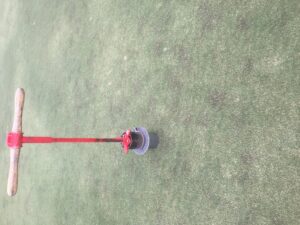
Aeration (coring) relieves compaction on athletic fields subject to heavy traffic. Aerate monthly when the grass is actively growing using ¾- to 1-inch-diameter tines that remove soil cores. Aerate the field lengthwise twice and crosswise once. To penetrate heavy clay soils, the field must be moist but not excessively wet (water several days in advance). Allow the plugs to dry, then pulverize them with a mower or power rake and redistribute them with a dragmat. More frequent coring may be necessary along heavily trafficked and compacted areas, such as around player benches, between hash marks, along sidelines, and in front of goals. Football fields may be aerated right after the last game of the season to avoid disrupting team play.
Aeration is absolutely necessary to maintain an acceptable field. Rent, borrow, or contract for these services if you do not have the equipment on hand. Do not aerate if the turf is under severe stress (extended periods of drought, etc.). It may take 3 weeks of good growing conditions for turf to recover after aeration. The field can be used while it is recovering.
Thatch removal is not usually needed for tall fescue fields but may be necessary for Kentucky bluegrass fields. Consider removing thatch thicker than ½ inch. Do not dethatch (using a vertical mower or power rake) in late spring or summer.
Renovation
See Grass Selection and Renovation sections.
Weed Control
Use a combination product to control postemergence winter annuals and perennial broadleaf (see Table 3). Apply at the product label rate. For more difficult-to-control weeds (corn speedwell, woodsorrel, wild violets, etc.), apply half the label rate and repeat in 10 to 20 days. The herbicides listed in Table 3 do not control grassy weeds. Do not use herbicides on newly seeded or renovated fields until new seedlings have been mowed at least three times (For more details, see Pest Control for Professional Turfgrass Managers, AG-408.)
|
Table 3. Application Rates for
Postemergence,
Broadleaf Herbicides
|
|
Product
|
Pints per acre
|
|
2,4-D + MCPP + dicamba (various trade names)
|
3 to 4
|
|
triclopyr + clopyralid (Confront)
|
1 to 2
|
|
2,4-D + clopyralid + dicamba (Millennium Ultra)
|
2 to 3
|
|
MCPA + triclopyr + dicamba (Horsepower) amine
formulation
|
2 to 3
|
|
MCPA + triclopyr + dicamba (Coolpower) ester
formulation
|
2 to 3
|
|
2,4-D + triclopyr (various trade names)
|
3
|
|
clopyralid (Lontrel Turf & Ornamental)
|
0.25 to 1.33
|
Return to Main Index
December through February
Mowing
Follow September-November guidelines.
Fertilization
Follow September-November fertilization guidelines. Fertilize between February 15 and March 15 at the rate of 1 pound of nitrogen per 1,000 square feet. Quick-release sources of nitrogen, such as urea (46-0-0) and ammonium nitrate (34-0-0), should be watered in immediately to prevent foliar burn.
Irrigation
Follow September-November guidelines. Irrigate dormant turf in warm, windy weather to prevent desiccation. Probe the soil to determine dryness.
Soil Cultivation
Do not cultivate at this time.
Renovation and Establishment
If worn or thin areas are heavily used in the fall, overseed with a suitable seed mixture.
Weed Control
Follow September-November guidelines.
Return to Main Index
March through May
Mowing
Follow September-November guidelines.
Fertilization
If the field was not fertilized in February, fertilize before March 15 at the rate of 1 pound of nitrogen per 1,000 square feet. Water in quick-release sources of nitrogen, such as urea (46-0-0) and ammonium nitrate (34-0-0), to prevent foliar burn.
Irrigation
Follow September-November guidelines.
Soil Cultivation
Do not cultivate soil when the temperature is consistently higher than 80oF.
Weed Control
Apply preemergence herbicides to control crabgrass, goosegrass, and foxtail around the time forsythia bushes are in bloom. If the area was reseeded in the spring, use only Tupersan (siduron).
|
Table 4. Application Rates for
Preemergence Herbicides
|
|
Product
|
Amount per acre
|
|
benefin (Balan 2.5G)
|
120 pounds
|
|
benefin + trifluralin (Team Pro 0.86G)
|
174 to 349
pounds
|
|
dithiopyr (Dimension 1EC)
|
2 quarts
|
|
oxadiazon (Ronstar 2G)
|
100 to 150
pounds
|
|
pendimethalin
|
5 pounds
|
|
(Weedgrass Control 60WP)
|
|
(Pre-M 60WP)
|
5 pounds
|
|
(Pendulum 60WDG)
|
5 pounds
|
|
(Pendulum 3.3 EC)
|
7.3 pints
|
|
prodiamine
|
0.75 to 1.5
pounds
|
|
(Barricade 65WG)
|
|
(Regal Kade 0.5G)
|
64 to 300 pounds
|
|
Siduron (Tupersan 50WP)
|
20 pounds*
|
|
* Use 8 pounds when
seeding tall fescue or Kentucky bluegrass.
|
Return to Main Index
Mowing
If fields will not be used during the summer, mow bluegrass to 2 ½ inches and tall fescue and tall fescue and bluegrass mixtures to 3 ½ inches. The taller mowing height promotes deep rooting and healthier plants. Follow the September-November mowing guidelines for fields in play.
Fertilization
DO NOT fertilize tall fescue or Kentucky bluegrass.
Once every 3 years, submit a soil sample for analysis to determine nutrient requirements for fall application.
Irrigation
Either irrigate as needed to prevent drought, or allow fields to go dormant. Follow the September-November irrigation guidelines. Dormant fields should be watered once every 4 weeks in a drought.
Soil Cultivation
Avoid soil cultivation.
Weed Control
Apply postemergent herbicides to control summer annual and perennial grasses, broadleaf weeds, and sedges in early June, if necessary. Apply herbicides only when grass is actively growing, has adequate soil moisture, and the temperature is less than 85oF. Avoid herbicide applications in mid-summer or in a severe drought. For broadleaf weed control recommendations, see Table 5 and Pest Control for Professional Turfgrass Managers, AG-408.
|
Table 5. Application Rates for
Postemergence Herbicides
|
|
Product
|
Amount per acre
|
Weeds controlled
|
|
fenoxaprop (Acclaim Extra 0.57EC)
|
13 to 39 fluid
ounces
|
crabgrass, goosegrass
|
|
quinclorac (Drive 75DF)
|
1 pound
|
crabgrass, foxtails, clovers, dandelion, and others
|
|
DSMA* (various trade names)
|
varies
|
crabgrass, goosegrass, bahiagrass, dallisgrass, purple
and yellow nutsedge, annual sedges, sandbur
|
|
MSMA* (various trade names)
|
varies
|
same as DSMA plus green kyllinga
|
|
bentazon
|
1 to 2 quarts
|
yellow nutsedge, annual sedge
|
|
(Basagran T/O 4S)
|
|
(Lescogran 4SL)
|
|
halosulfuron (Manage 750F)
|
0.67 to 1.33
ounces
|
yellow and purple nutsedge, green kyllinga
|
|
*
Tall fescue and
Kentucky bluegrass have intermediate tolerance to these products. Use with
caution and at reduced or minimum label rates.
|
Return to Main Index
Tall fescue, a relatively coarse-textured grass, is fairly pest tolerant, and it is the most heat- and drought-tolerant of the cool-season grasses. However, it is coarser in texture and less heat- and drought-tolerant than bermudagrass. It doesn’t spread and doesn’t tolerate mowing shorter than 2 ½ to 3 inches. To improve the recuperative potential of a tall fescue lawn, it is often seeded in combination with Kentucky bluegrass at the rate of 6 pounds of tall fescue to 1 pound of Kentucky bluegrass per 1,000 square feet.
K-31 tall fescue is an economical standard in seed mixtures, but a number of improved turf-type tall fescues are on the market. These grasses tend to be darker green, have a finer leaf texture, have greater shoot density, withstand lower mowing, and are more disease tolerant. However, there is little research to support claims of improved heat and drought tolerance. Both K-31 and the turf-type tall fescues need similar care and management, although the turf-type tall fescues can be mowed approximately ½ inch shorter than K-31 and may be better suited for baseball infields. The following cultivars have shown good or very good performance in North Carolina.
Very good: Adventure II, Barlexus, Bonanza, Finelawn Petite, Genesis, Lancer, Marksman, Mini-Mustang, Phoenix, Rebel 3D, Safari, Shenandoah, Southern Choice, Tarheel, Taurus, Thoroughbred, Tomahawk.
Good: Adventure, Amigo, Avanti, Apache, Barnone, Crossfire, Emperor, Finelawn, Finelawn 5GL, Houndog, Jaguar II, Mesa, Murietta, Mustang, Olympic, Olympic II, Rebel Jr., Rebel II, Rebel III, Richmond, Shortstop, Titan, Twilight, Vegas, Wrangler.
Kentucky bluegrass is a fine-textured, sod-forming grass that can be seeded alone or in combination with tall fescue or perennial ryegrass. It is very resilient and makes an excellent infield but is very slow to establish. Kentucky bluegrass performs well alone (when seeded at a rate of 2 pounds per 1,000 square feet) in the higher elevations of western North Carolina but should be combined with tall fescue in the lower elevations or at the eastern edge of the mountains. Blending two or more improved Kentucky bluegrass cultivars enhances performance over a wide range of conditions. A mix of 50 percent Kentucky bluegrass and 50 percent perennial ryegrass seeded at 2.5 pounds per 1,000 square feet also provides an acceptable playing surface as long as dollarspot and red thread diseases are not a threat. Some Kentucky bluegrass cultivars that have shown very good and good performance in North Carolina include:
Very good: A34, Aspen, Blacksburg, Bristol, Classic, Coventry, Eclipse, Explorer, Georgetown, Kelly, Monopoly, Nassua, Parade, Ram I, Rugby, Suffolk.
Good: Abbey, Able-I, Alene, Amazon, America, Ascot, Asset, Baron, Challenger, Chateau, Cheri, Chicago, Cynthia, Glade, Gnome, Huntsville, Jefferson, Kenblue, Livingston, Merit, Midnight, Nuglade, Princeton, Unique, Victa, Washington.
Perennial ryegrass is well adapted to the western region of North Carolina and may be used when quick establishment is desired. It can be combined with Kentucky bluegrass when red thread and dollarspot are not a major threat. A mixture of 50 percent Kentucky bluegrass and 50 percent perennial ryegrass seeded at 2.5 pounds per 1,000 square feet is the easiest and quickest grass to establish. This seed mixture results in excellent traffic and wear tolerance. However, it does not spread laterally and often requires reseeding to fill in bare areas that may result from divoting and excessive wear. Some cultivars that have shown good performance in national trials are Accent, Brightstar II, Caddieshack, Calypso II, Catalina, Esquire, Line Drive, Manhattan 3, Palmer III, Panther, Passport, Pennant II, , Prelude III, Premier II, Prizm, Secretariat, Top Hat.
Return to Main Index
When to Plant
Cool-season grasses are best seeded from mid-August in the western region to mid-October in the Piedmont and Coastal Plain. However, renovation of football fields must often be postponed until after the playing season has ended. Football fields are occasionally seeded in February in the Coastal Plain and Piedmont and March in the western region. Seeding too early in the fall or spring can result seedling diseases. Seeding too late in the spring can result in weed competition, diseases, heat stress, and drought stress.
When fields are used in both spring and fall, only sodding can be used to establish new turf. It is better to keep an existing field in good shape by following all the recommended management practices in this publication. Adding perennial ryegrass to seed mixtures may result in quicker establishment and, in turn, earlier use of the field. However, keep in mind that perennial ryegrass is usually a poor choice for a permanent cover because it is susceptible to diseases and heat.