March through May
June through August
September through November
December through February
More About St. Augustinegrass
Disclaimer
Lawn Maintenance Calendar
This calendar of suggested management
practices is designed to assist you in the seasonal care of your lawn. Location, terrain,
soil type and condition, age of the lawn, previous lawn care, and other factors affect
turf performance. For these reasons, tile following management practices and dates should
be adjusted to suit your particular home lawn conditions.
March through May
Mowing
Before greenup, remove dormant grass leaves by mowing to 2 ½ inches
with a rotary mower that has a newly sharpened blade. Maintain the lawn at 2 ½ inches,
mowing before it gets to 4 inches. Leave clippings on the lawn.
Fertilizing
Apply ½ pound of nitrogen (N) per 1,000 square feet in May or 2
weeks after greenup, whichever is last. Use a complete (N-P-K) turfgrade fertilizer with a
3-1-2 or 4-1-2 ratio (12-4-8 or 16-4-8). Yellow appearance may indicate an iron
deficiency. Spray iron (ferrous) sulfate (2 ounces in water per 1,000 square
feet) or a chelated iron source to enhance color as needed. Submit a soil
sample to determine nutrient requirements, if you haven’t already. (Contact
your county Cooperative Extension agent for details.) Apply lime if the
soil-test report suggests it.
Watering
Actively growing St. Augustinegrass
requires about 1 inch of water per week, all at once, if possible. If you don’t
get enough rain, you will have to water. Sandy soils often require more
frequent watering (½ inch every third day). Proper irrigation may prevent or
reduce pest and other problems.
Weed Control
If crabgrass and goosegrass have been a problem, apply preemergence
herbicides by the time dogwoods are in full bloom. Control broadleaf weeds as necessary
with postemergence herbicides. St. Augustinegrass is sensitive to certain
herbicides (2,4-D and MSMA), so follow label directions and use caution.
Insect Control
Control any white grubs. If drought symptoms or yellow spots occur
in a sunny location, check for chinch bug activity. Push a coffee can (with both top and
bottom removed) into the ground and fill it with water. Any chinch bugs present
will float. Treat for chinch bugs if you have 20 or more chinch bugs per 1,000
square feet. (See White Grubs in Turf, ENT/ORT-67, AG-366), and Insect Management in
Turf, AG-447 for more information.
Disease Control
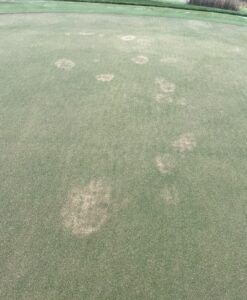
If circular patches of brown grass up to several feet in diameter
appear, you may have Brown (Large) Patch. Gray Leaf Spot also may be a problem. Control
both diseases as necessary with proper fungicides. (See Turfgrass Pest Management Manual: A Guide to Major Turfgrass Pests and Turfgrasses, AG-348 for more information.)
Aerate
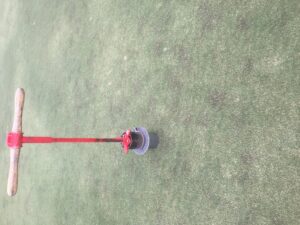
Heavy clay soils or heavily trafficked sections of lawn may benefit
from aeration. If it is needed, aerate in late spring or early summer when the grass
is actively growing and capable of recovery.
Renovation
Replant large bare areas in May (or when daytime temperatures are
continually above 60oF) using plugs planted on 12-inch centers or sprigs space-planted at
the rate of 1 ½ bushels per 1,000 square feet. (One square yard of turf pulled
apart is equivalent to 1 bushel of sprigs.)
Return to Main Index
Mowing
Same as March through May guidelines.
Fertilizing
Apply ½ pound of nitrogen per 1,000 square feet in June and August
and 1 pound of nitrogen in July. In the absence of a soil test, use a complete (N-P-K)
fertilizer with a 3-1-2 or 4-1-2 ratio.
Watering
Same as March through May
guidelines.
Thatch
If thatch was ¾ inches thick last summer, mow grass to 2 ½
inches and use a power rake with 3-inch blade spacing.
Weed Control
Apply postemergence herbicides to control summer annual and perennial
broadleaf weeds, such as knotweed, spurge, and lespedeza. Since St. Augustinegrass is
sensitive to certain herbicides (2,4-D and MSMA), follow label directions and
use with caution. Do not apply herbicides unless weeds are actively growing and
the lawn is not under drought stress. If crabgrass and goosegrass are present,
make a note to apply a preemergence herbicide next spring.
Insect Control
If drought symptoms or yellow spots occur in a sunny location,
check for chinch bug activity. Push a coffee can (with both top and bottom removed) into the
ground and fill it with water. Any chinch bugs present will float. Treat for
chinch bugs if you have 20 or more chinch bugs per 1,000 square feet. (See
Insect Management in
Turf, AG-447 for more information.)
Disease Control
Check for Gray Leaf Spot and Brown (Large) Patch.
(See Diseases of
Warm-Season Grasses, AG-360.)
Return to Main Index
September through November
Mowing
Same as March through May guidelines.
Fertilization
DO NOT fertilize St. Augustinegrass after August 31.
Watering
Water to prevent drought stress while the grass is actively
growing and after the lawn goes dormant to prevent excessive dehydration.
Insect Control
Follow June through August guidelines.
Thatch
Check for thatch layer in early September. If the thatch layer is
¾ inches thick, plan to dethatch in the spring.
Weed Control
If crabgrass and goosegrass are present, plan to apply a preemergence
herbicide next spring.
Disease Control
Check for Brown (Large) Patch (See
Diseases of
Warm-Season Grasses, AG-360.)
Return to Main Index
December through February
Mowing
Pick up debris (rocks, sticks, leaves, etc.) from lawn. Do not try
to remove excess debris by burning. This could injure the lawn and is a fire hazard.
Fertilization
Do not apply fertilizer or lime.
Watering
Although the lawn will be dormant, water occasionally to prevent
excessive dehydration.
Weed Control
Apply broadleaf herbicides to control chickweed, henbit, etc.
St. Augustinegrass is sensitive to certain postemergence herbicides like 2,4-D and MSMA,
so follow label directions for reducing rates, and use with caution. Selected herbicides
like atrazine and simazine can be applied in November or December to control
annual bluegrass and several winter annual broadleaf weeds. Read the label and
follow directions carefully.
Return to Main Index
More About St. Augustinegrass
This fast growing grass has a medium to dark green color and very
coarse leaf texture. With proper maintenance, it provides a dense, lush lawn. A warm-season
grass, it’s best in warm, humid areas not exposed to excessive or intense
periods of cold weather. The “Raleigh” variety has the best cold tolerance and
is best suited for the eastern piedmont and coastal plains.
St. Augustinegrass can only be planted vegetatively. It grows best
in fertile, well-drained soils. It has excellent tolerance to shade and good salt, heat,
and, to a moderate extent, drought tolerance. It does not tolerate heavy
traffic or cold weather.
Since it is fast growing, St. Augustinegrass needs to be mowed
frequently. It should never receive more than 4 pounds of nitrogen per 1,000 square feet in a
year. With high fertilization rates and irrigation, thatch buildup may be a
problem. Thatch can lead to other problems, such as disease and insect damage.
Chinch bugs are often a problem, causing leaves to wilt and turn brown. Yellow
spots are often associated with chinch bug activity. In addition, Brown (Large)
Patch can create brown circular patches up to several feet in diameter that
usually warrant treatment.
St. Augustinegrass is sensitive to some postemergence herbicides,
such as 2,4-D and MSMA; however, some herbicides can be used at lower rates. Read and follow
label directions carefully. Following the management practices in this fact
sheet is the best means of preventing and controlling problems in your St.
Augustinegrass lawn. Continual loss of grass may mean that you need to select a
different turfgrass species, one that is better adapted to your particular
yard. Contact your county Extension agent for help in identifying and solving
turfgrass problems
Return to Main Index
DISCLAIMER:
Recommendations for the use of agricultural chemicals are included in this
publication as a convenience to the reader. The use of brand names and any
mention or listing of commercial products or services in this publication does
not imply endorsement by the North Carolina Cooperative Extension Service nor
discrimination against similar products or services not mentioned. Individuals
who use agricultural chemicals are responsible for ensuring that the intended
use complies with current regulations and conforms to the product label. Be
sure to obtain current information about usage regulations and examine a
current product label before applying any chemical. For assistance, contact
your county Cooperative Extension Service agent.
Prepared by: Arthur H. Bruneau, Crop
Science Extension Specialist, Turfgrass
Matthew C. Martin, Area Specialized Agent, Turfgrass,
Henry C. Wetzel, Extension Plant Pathology Specialist,
Turfgrass
Rick L. Brandenburg, Extension Entomologist,
Fred H. Yelverton, Extension Crop Science Specialist,
Turfgrass Weed Management,
Cale A. Bigelow, Extension Associate, Turfgrass
Published by North Carolina Cooperative Extension Service
Publication Number: AG-540 Revised: May, 2004
This Electronic Revision: January, 2008
© 2008 TurfFiles