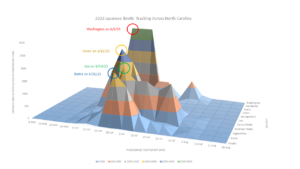
Rounds 4 Research: Bid for foursomes and golf packages at first-class courses across North and South Carolina. Proceeds benefit turfgrass research programs at North Carolina State University and Clemson University.
North Carolina Cooperative Extension
College of Agriculture and Life Sciences - NC State University
Turfgrass Council of North Carolina The North Carolina Turfgrass Research & Education Foundation (NCTF)
North Carolina Sports Turf Association
North Carolina Sod Producers Association

Diseases of Warm Season Grasses (AG-360)

Article contains terms, results, and products that are targeted to home owners. Article contains terms, results, and products that are targeted to turf professionals.
Art Bruneau
Feb 22, 2001
Printable PDF
(120.4 kB)

Diseases of Warm-Season Grasses

Bermudagrass, Centipedegrass, Zoysiagrass, and St. Augustinegrass


Leon T. Lucas, Extension Plant Pathology Specialist
Arthur H. Bruneau, Extension Crop Science Specialist


Published by North Carolina Cooperative Extension Service
Publication Number: AG-360 Revised: April 1994
Last Electronic Revision: August 1995 (MPR)


This guide is designed to help you identify the most troublesome diseases associated with warm-season turfgrasses. These include such grasses as bermudagrass, centipedegrass, St. Augustinegrass, and Zoysiagrass. A description of the major disease symptoms, a listing of specific management practices that can be used to prevent or reduce turfgrass energy by disease, and a chart to indicate when the disease is most likely to occur are presented.

Disease development is dependent on susceptible plants, a favorable environment and a pathogen. Diseases will not occur unless all factors are present simultaneously over a certain period. Management practices that favor a healthy turf such as planting improved, adapted cultivars, proper fertilization, and timely watering (for example, avoiding late evening watering) can prevent or limit turf injury by diseases.

Inspect your lawn frequently to detect diseases early. Correct identification of a disease may require the assistance of a qualified individual. Environmental stresses, improper lawn care practices, and insect pests often display symptoms that resemble diseases. If a fungicide is necessary, correctly identify the disease, select the proper fungicide, follow label directions, and apply it at the correct rate and time. Contact your county extension agent, another qualified individual, or refer to the North Carolina Agricultural Chemicals Manual for additional information.


Brown Patch (Rhizoctonia spp.)

Brown Patch

Turf Affected

Bermudagrass and St. Augustinegrass

Symptoms

Circular brown areas up to 20 feet in diameter that develop during cool, wet weather in the spring or fall. Leaves wilt and die, resulting in large brownish tan areas. Brown patch usually is present in bermudagrass at time of spring greenup.

Management

Provide good drainage and avoid excessive nitrogen fertilization. The turf usually recovers in warm, dry weather.

Time Disease Occurs

Time line for disease
Return to Index

Centipede Decline

Centipede Decline

Turf Affected

Centipedegrass

Symptoms

Circular dead areas appear in the spring and continue to enlarge during the summer. Grass at edges of areas may yellow, wilt, and die during stress periods.

Management

Maintain soil pH between 5 and 5.5 and avoid excessive rates of nitrogen (use 1 lb N or less / 1,000 sq. ft. / year) and phosphorus fertilizers. Ensure adequate potassium in summer and fall. Maintain the turf at 1 inch mowing height and apply iron to foliage if yellow. Avoid drought stress. If nematodes are causing the decline, irrigate as needed or select another type of grass.

Time Disease Occurs

Time disease occurs
Return to Index

Dollar Spot (Sclerotinia Homoeocarpa)

Dollar Spot

Turf Affected

Centipedegrass, Bermudagrass, and Zoysiagrass

Symptoms

Straw-colored patches 2 to 6 inches in diameter develop in late summer. Light tan lesions with reddish brown margins develop across leaves.

Management

Adequate fertilizer will help the turf overcome this disease. Irrigate turf as needed to avoid drought stress.

Time Disease Occurs

Time Disease Occurs
Return to Index

Fairy Rings (Mushroom-type fungi)

Fairy rings

Turf Affected

All types

Symptoms

Large arcs or rings of very green grass, dead grass, mushrooms, puffballs, or a combination of these symptoms.

Management

Remove organic matter (stumps, waste lumber) from soil before planting. Power rake to remove thatch when it exceeds 1/2 inch. Remove soil cores, spike or force water into affected areas to allow nutrient and water penetration. Avoid overfertilization in an attempt to mask the green rings. Soil fumigation or rototilling and replanting may eliminate fairy rings.

Time Disease Occurs

Time Disease Occurs
Return to Index

Gray Leaf Spot (Pyricularia Grisea)

 Gray Leaf Spot

Turf Affected

St. Augustinegrass

Symptoms

Oval or circular tan lesions that are bordered by purple to brown margins develop in warm, wet weather. Leaves wither and die if many lesions develop, giving the turf a brownish color.

Management

Avoid excessive fertilization with nitrogen when warm, humid weather is expected. Avoid late afternoon and evening watering. Prune trees and undergrowth to improve air movement and light intensity.

Time Disease Occurs

Time Disease Occurs
Return to Index

Leaf Spot (Helminthosporium spp.)

Leaf Spot

Turf Affected

Bermudagrass

Symptoms

Dark, circular, or oval-shaped lesions develop on blades and stems. Some lesions become red, purple, or tan with dark margins. Turf appears yellow to brown if the disease is severe and becomes thin.

Management

Fertilize properly and avoid close mowing in late spring and summer. Keep mower blade sharp. Water deeply but infrequently and avoid prolonged leaf wetness.

Time Disease Occurs

Time Disease Occurs
Return to Index

Rust (Puccinia spp.)

Rust

Turf Affected

Zoysiagrass

Symptoms

Small yellow specks on leaves and stems that develop into orange or red pustules. Heavily infected lawns take on orange or reddish hue and the turf becomes thin and weak. Rust is most often a problem in lawns with too much shade.

Management

Ensure adequate fertilization and dispose of clippings when symptoms are evident. Remove excess shade and maintain good soil moisture. Several fungicides can be used to help control the disease.

Time Disease Occurs

Time Disease Occurs
Return to Index

Slime Mold (Mucilago, Physarum, Fuligo spp.)

Slime Mold

Turf Affected

All grasses

Symptoms

White, gray, powdery fruiting bodies that cover leaves in patches 6 to 12 inches in diameter during warm, wet weather. Fungus usually disappears during dry weather.

Management

Remove by brushing, mowing, or washing the turf. Slime molds are not considered harmful and do not require fungicide treatment.

Time Disease Occurs

Time Disease Occurs
Return to Index

Spring Dead Spot

Spring Dead Spot

Turf Affected

Bermudagrass

Symptoms

Dead spots appear in the spring as grass resumes growth, usually after lawn is at least 3 to 5 years old. Spots expand for 3 to 4 years, often developing into rings, and then disappear. Infected areas recover slowly and weeds frequently invade these areas during the summer.

Management

Avoid excessive nitrogen fertilization and do not apply nitrogen after late August. Raise mowing height and ensure adequate potassium in the fall. Reduce thatch by aerifying and pulvarizing soil cores. Some fungicides can be used in the fall to control this disease.

Time Disease Occurs


Return to Index

Nematodes (sting)

Nematodes

Turf Affected

All grasses

Symptoms

Turf becomes thin and does not grow well following fertilization and irrigation. This occurs most often in sandy soils. Roots are shallow and may be killed. Have soil samples assayed by the North Carolina Department of Agriculture to determine if nematodes are a problem.

Management

Plant the best-adapted turfgrasses and ensure adequate fertilization and irrigation to help overcome nematode damage. Nematicides are not labeled for use on residential turf.

Time Disease Occurs


Return to Index

Integrated Pest Management

The Sensible Approach to Lawn Care

Many pest problems that cause your turf to look bad--diseases, weeds, insects and animals. If you are really unlucky, you may have all of them at one time.

So what do you do? Use a pesticide? Or, make changes in cultural practices? Both methods, or some others as well, may be needed. The balanced use of all available methods is called INTEGRATED PEST MANAGEMENT (IPM).

The idea is simple. It encourages the use of all available prevention and control methods to keep pests from reaching damaging levels. The goal is to produce a good turf and minimize the influence of pesticides on man, the environment and turf.

IPM methods include:

  1. Use of best adapted grasses.
  2. Proper use of cultural practices such as watering, mowing, and fertilization.
  3. Proper selection and use of pesticides when necessary.

Early detection and prevention, or both, will minimize pest damage. saving time, effort and money. Should a problem occur, determine the cause or causes, then choose the safest, most effective control or controls available.

When chemical control is necessary, select the proper pesticide, follow label directions, and apply when the pest is most susceptible. Treat only those areas in need. Regard pesticides as only one of many tools available for turf care.

To learn more about integrated pest management, pest identification, turf care, and proper use of pesticides, contact your county Cooperative Extension Center.

KEYWORDS FOUND IN THIS ARTICLE:
bermudagrass
fungicide
management
spring dead spot
brown patch
fungus
melting out
St. Augustinegrass
centipedegrass
gray leaf spot
mowing
take all patch
dead spot
helminthosporium
nematodes
thatch
dollar spot
irrigation
nitrogen
turfgrass maintenance
drought
large patch
pesticide
turfgrass management
dry weather
lawn care
potassium
warm season
fairy ring
lawn maintenance
rust
watering
fertilizer
leaf spot
slime mold
zoysiagrass
TurfFiles Logo Copyright © 2000-2010 North Carolina State University. All Rights Reserved.
TurfFiles Logo TurfFiles is funded by the Center for Turfgrass Environmental Research & Education (CENTERE) through public and private grants.