|
|
Updating ...
SPRING DEAD SPOT
Spring Dead Spot
[Ophiosphaerella korrae & Ophiosphaerella herpotricha]
SYMPTOMS
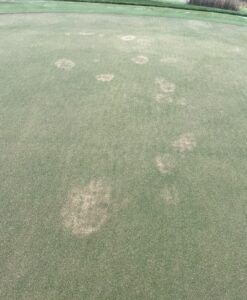
Spring dead spot symptoms appear in circular patches from 6 inches to several feet in diameter that remain dormant as the turf greens up in the spring. These patches eventually die and collapse to the soil surface. The roots, stolons, and rhizomes are dark and rotten in affected areas. Spring dead spot patches recur in the same spot each year and increase in size by up to several inches each season. As the patches expand, the centers are sometimes re-established with bermudagrass or weedy species, resulting in a ring-like appearance. Recovery of the patches occurs by spread of the bermudagrass from the outside. This process is very slow, taking the entire growing season in severe situations. The spring dead spot patches greatly detract from the uniformity of the playing surface and are frequently invaded by weeds. Spring dead spot may also occur in certain varieties of zoysiagrass, such as ‘Meyer’ and ‘El Toro’.
|
spring dead spot root and stolon rot |
Characteristic |
Description |
|
Host Grass Species |
bermudagrass, zoysiagrass |
|
Month(s) with symptoms |
April to September |
|
Stand Symptoms |
spots, circles, patches (6 inches to greater than 3 feet), rings |
|
Foliar Symptoms - Location/Shape |
blighting of entire leaves |
|
Foliar Symptoms - Color |
tan, yellow, orange |
|
Root/Crown Symptoms |
roots, stolons, rhizomes, and/or crowns dark brown or black |
|
Fungal Signs |
none |
Note: Still not sure if this is the right disease? The Turfgrass Disease Identification program may be helpful. Or consult the experts at the Turf Diagnostics Lab. Check the TurfFiles glossary for definitions of unfamiliar terms.
FACTORS AFFECTING DISEASE DEVELOPMENT
Spring dead spot is most evident on intensely managed bermudagrass, such as athletic fields and golf courses. The disease typically takes 3 to 5 years to become established in a new bermudagrass stand. Unlike take-all patch, spring dead spot does not decline in severity as the turf matures. It becomes more severe if left unmanaged.
The spring dead spot fungus attacks the roots, rhizomes, and stolons of bermudagrass during the fall and winter. This activity does not directly kill the plant, but instead makes the bermudagrass more susceptible to freezing injury. As a result, spring dead spot is most severe in the northern range of bermudagrass adaptation and is usually more severe after extremely cold winters.
Any factor that restricts bermudagrass root growth or increases its susceptibility to winter injury will also enhance the disease. Excessive nitrogen, potassium deficiencies, poor soil drainage, over-irrigation, excessive thatch accumulation, and soil compaction have been shown to encourage disease development. The impact of soil pH on spring dead spot development in bermudagrass is not well understood.
CULTURAL CONTROL
Fertilize to meet the nutritional needs of the turf, but do not apply excessive rates of nitrogen. Do not apply nitrogen within 6 weeks of winter dormancy, and do not exceed more than 1 pound of nitrogen per 1,000 square feet per application at any time during the growing season. Reduce thatch buildup and relieve soil compaction through aggressive aerification and vertical mowing. Areas that are severely affected by spring dead spot should be hollow-tine aerified at least three times per year, during the summer when bermudagrass is most actively growing. Golf greens should also be topdressed along with aerification to control thatch accumulation.
The impact of soil pH on spring dead spot development is unclear at this time. Past recommendations focused on the use of acidifying nitrogen sources like ammonium sulfate to manage this disease. However, recent research at NC State University has shown that different spring dead spot pathogens respond differently to nitrogen sources. Ophiosphaerella korrae, the most common pathogen in the eastern US was controlled effectively by application of calcium nitrate as the sole nitrogen source. On the other hand, O. herpotricha, the most common pathogen in midwestern states, was suppressed by ammonium sulfate. Fall applications of potassium, which have been frequently recommended for spring dead spot management, had no effect on the disease in our research.
Once the symptoms of spring dead spot appear, the only means of control is to encourage the spread of bermudagrass into the affected patches. Frequent spiking or aerification is recommended to break up the mat of dead turf in affected patches. Applying extra nitrogen to encourage recovery is not recommended, as this can enhance the disease in the following year. Dinitroaniline (DNA) herbicides, which are commonly used for preemergent control of annual grasses, can slow the recovery of bermudagrass from spring dead spot injury and should not be used in sites with a history of the disease.
CHEMICAL CONTROL
Fungicides are available for spring dead spot control, but they must be applied preventatively in the fall. Fenarimol and tebuconazole have been the most effective and consistent fungicides for spring dead spot control. Applications are most effective when soil temperatures are between 60 and 80°F. To move the fungicide into the root zone, apply in a high volume of water (5 gallons per 1,000 square feet) or water in with ¼” of irrigation immediately after application. Repeat applications at high label rates may be necessary in severely affected areas. Affected areas should be mapped in the spring for treatment in the fall to reduce fungicide expenditures.
|
Fungicide |
Efficacy (1) |
Resistance Risk (2) |
Class (3) |
Products (4) |
|
fenarimol** |
+++ |
2 |
DMI |
Rubigan |
|
tebuconazole** |
+++ |
2 |
DMI |
Torque |
|
azoxystrobin + propiconazole |
+++ |
3 |
DMI + QoI |
Headway |
|
propiconazole |
++ |
2 |
DMI |
Banner MAXX, Kestrel, Kestrel MEX, ProPensity, Propiconazole, Propiconazole G-Pro, Propiconazole Pro, Savvi, Spectator, Strider |
|
chlorothalonil + propiconazole** |
++ |
2 |
DMI + nitrile |
Concert |
|
chlorothalonil + propiconazole + fludioxonil** |
++ |
2 |
DMI + nitrile + phenylpyrolle |
Instrata |
|
flutolanil + thiophanate-methyl |
+ |
3 |
benzimidazole + carboxamide |
SysStar |
|
iprodione + thiophanate-methyl** |
+ |
3 |
benzimidazole + dicarboxamide |
26/36, Dovetail, Fluid Fungicide |
|
chlorothalonil + thiophanate-methyl** |
+ |
3 |
benzimidazole + nitrile |
Spectro, ConSyst, Peregrine, Tee-1-Up, TM/C |
|
mancozeb + myclobutanil** |
+ |
2 |
dithiocarbamate + DMI |
Manhandle |
|
myclobutanil |
+ |
2 |
DMI |
Eagle, Myclobutanil |
|
azoxystrobin |
+ |
3 |
QoI |
Heritage |
|
thiophanate-methyl |
? |
3 |
benzimidazole |
3336, Fungo, Systec, T-Bird, T-Storm, Tee-Off, TM |
|
triticonazole |
? |
2 |
DMI |
Trinity, Triton |
|
fluoxastrobin |
? |
3 |
QoI |
Disarm, Disarm G |
|
** Not for application to residential lawns. |
|
Footnotes: |
|
(1) |
Efficacy Codes: |
|
++++ |
excellent control when conditions are highly favorable for disease development |
|
+++ |
good control when disease pressure is high, or excellent control when disease pressure is moderate |
|
++ |
good control when disease pressure is moderate, excellent control when disease pressure is low |
|
+ |
good control when disease pressure is low |
|
0 |
does not provide adequate control under any conditions |
|
? |
cannot be rated due to insufficient data |
|
(2) |
Resistance Risk: |
|
1 |
Rotating and tank-mixing not necessary, but recommended to avoid potential side effects from continuous use of same chemical class. |
|
2 |
Rotate to different chemical class after 3-4 applications; tank-mixing not necessary. |
|
3 |
Rotate to different chemical class after 2-3 applications; tank-mixing not necessary. |
|
4 |
Rotate to different chemical class after 1-2 applications; tank-mixing not necessary. |
|
6 |
Rotate to different chemical class after 1-2 applications; tank-mixing with low or moderate risk product recommended. |
|
9 |
Rotate to different chemical class after EVERY application; tank-mix with low or moderate risk product for EVERY application. |
|
(3) |
Continual use of fungicides with similar control mechanisms (modes of action) can result in fungi that are resistant to some chemicals. Poor or ineffective disease control can be expected when this occurs. Managers can reduce the chances of this happening by mixing or alternating fungicides belonging to different chemical classes. |
|
(4) |
Recommendations of specific chemicals are based upon information on the manufacturer's label and performance in a limited number of trials. Because environmental conditions and methods of application may vary widely, performance of the chemical will not always conform to the safety and pest control standards indicated by experimental data. When more than one brand name exists for an agricultural chemical, the name of brand that first came onto the market is listed first. Otherwise, brand names are listed in alphabetical order. The order in which brand names are given is not an indication of a recommendation or criticism. |
|
Recommendations for the use of agricultural chemicals are included in this publication as a convenience to the reader. The use of brand names and any mention or listing of commercial products or services does not imply endorsement by North Carolina State University or discrimination against similar products or services not mentioned. Other brand names may be labeled for use on turfgrasses. Individuals who use agricultural chemicals are responsible for ensuring that the intended use complies with current regulations and conforms to the product label. Be sure to obtain current information about usage regulations and examine a current product label before applying any chemical. For assistance, contact your county's Cooperative Extension agent. |
© North Carolina State University. This information sheet was prepared by Lane P. Tredway, Gail G. Wilkerson, Bridget R. Lassiter, Jenifer J. Reynolds, and Gregory S. Buol. Departments of Plant Pathology and Crop Science, College of Agriculture & Life Sciences, North Carolina State University. Prepared March 7, 2011. Available on-line at www.turffiles.ncsu.edu. This publication was made possible through a grant provided by the Center for Turfgrass Environmental Research & Education (CENTERE) whose purpose is to support worthwhile projects that will benefit both the private sector and the public, and protect the environment.
KEYWORDS FOUND IN THIS ARTICLE:
|