|
|
Updating ...
TurfFiles
May TurfTips
Water actively growing lawns as needed. Most turfgrasses
need 1 to 1¼ inches of water, including rainfall, per week. Apply nitrogen to
St. Augustinegrass lawns two weeks after greenup. Apply postemergence
herbicides after full green-up as necessary to control summer annual and
perennial broadleaf weeds. In late May, start replanting bare or worn areas in
warm-season turfs such as bermudagrass and centipedegrass, and remove thatch if
it is thicker than ½ inch. Check for white grubs and mole crickets so appropriate
control measures for the next generation can be applied in high risk areas in
June or July. Refer to the turf specific maintenance
calendars for detailed information.
Maintenance calendars provide suggested management practices to assist you in seasonal
care of home lawns and athletic fields grown in North Carolina. Location, terrain,
soil type and condition, age of turf, previous management, and other factors affect
turf performance. For these reasons, the management practices and dates found in
the following maintenance calendars should be adjusted to suit your particular turf
conditions.
Both warm and cool season turfgrasses are grown in North Carolina. Knowing turfgrass
growth characteristics and use recommendations is important for maintaining a healthy
turfgrass system and minimizing management requirements. Following is a list of
turfgrasses commonly grown in North Carolina.
There are over 100 diseases that affect North Carolina turfgrasses. Fortunately,
there are only about 18 tufgrass diseases that develop year after year. Following
is a list of the most common diseases that affect North Carolina turfgrasses.
Many insects live in or on turf. Some damage turfgrasses by feeding on roots, leaves
and stems while others disturb roots by making burrows. Below is a list of the major
insects which damage turfgrasses in North Carolina.
Pests that are not insects, diseases, or weeds are included in the catch-all category
of "Other Pests" on TurfFiles.
Weeds by definition are any plant(s) that grow where not intended. Whereas some
grass species are classified as both turfgrasses and weeds, all broadleaves and
sedges are considered weeds within any successful turfgrass program. Following is
a list of common weeds found in North Carolina turfgrassess.
|
|
|
|
|
|
|
|
|
|
|
|
|
The District Director changes will take effect January 1, 2012. Changes to 4-H District Activity Days and volunteer districts such as Master Gardeners and ECA will take place later in 2012.
|
|
|
|
|
|
|
|
|
|
|
|
|
|
|
|
|
|
|
|
|
|
|
|
|
|
|
|
|
|
|
|
|
|
|
|
|
|
|
|
|
|
|
|
|
|
|
|
|
|
|
|
|
|
|
|
|
|
|
|
|
|
|
|
|
|
|
|
|
|
|
|
|
|
|
|
|
|
|
|
|
|
|
|
|
|
|
|
|
|
|
|
|
|
|
|
|
|
|
|
|
|
|
|
|
|
|
|
|
|
|
|
|
|
|
|
|
|
|
|
|
|
|
|
|
|
|
|
|
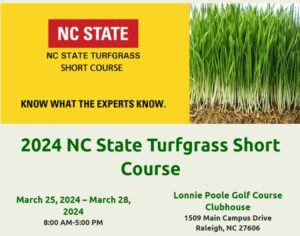
Once again this winter NC State University, in cooperation with TCNC, will be offering our 13th Annual Turfgrass Short Course.
Date: Jan. 12-16, 2008 Location: McKimmon Center, Raleigh NC Downloads: Brochure with Registration Form
ONLINE REGISTRATION
|
|
|
|
|
|
|
|
|
The News & Observer talks to Dr. Grady Miller to learn about the impact of drought and what to do next. Read article
|
|
|
|
|
|
|
|
|
|
|
|
|
|
|
|
|
|
|
|
|

In a recent review of turfgrass programs in the United States, TurfNET magazine recognized the undergraduateTurfgrass Management Programs at NC State University as #1 IN THE NATION.
|
|
|
|
|
|
|
|
|
|
|
Listed below are the most recent public presentations.
To view all presentations click
here.
|
|
|
|
|
|
|
|
|
|
Weed Management
- Fred Yelverton
|
|
|
|
|
|
|
|
|
|
The Carbon Calculator NEW!
Carbon Storage - As plants photosynthesize and grow, they take up molecules of carbon dioxide gas. The carbon and oxygen atoms that make up carbon dioxide are used to build the many parts of all plant cells. In this way, carbon is taken out of the atmosphere and accumulated in plant systems. This carbon storage (sequestration) involves leaves, stems, and roots of all plants, trunks
of trees, and the soil when dead plant parts are deposited there.
In home landscapes, trees and turfgrasses are two types of plants that may store significant amounts of carbon. This calculation tool will use measurements that you make in your yard to estimate the total amount of carbon being stored.
Estimates in the calculator are based on averages of data that are currently available. Scientists and industry are continuing to assess carbon release and storage processes, so calculations of carbon footprints may become more precise in the future. Many factors influence the exact amount of carbon that is taken up by a plant. Some tree species, for example, inherently grow and accumulate carbon faster than others. Turfgrass tends to accumulate carbon more quickly when it is first planted than when it is well-established. And of course, plants that are healthy and growing will store more carbon than those that are not.
Carbon Emissions - When fossil fuels are burned, the carbon stored in them is converted into carbon dioxide gas that is released, or emitted, into the atmosphere. This calculation tool will ask questions about your family’s lawn maintenance practices and automobile driving to make estimates of carbon emissions that you can compare with the amount of carbon storage.
Disease Identification

Many diseases occur on the turfgrasses that are used throughout North Carolina.
Most of the diseases included here are caused by fungi. Some problems that resemble
diseases are caused by environmental or management factors such as cold, heat, drought,
high soluble salts, soil compaction, or chemical damage. Careful identification
of the cause of a problem is important for the selection of proper control methods.
Disease Management

The disease management decision aid returns a list of active ingredients (AIs), ranked according to efficacy, based on the user’s input of turfgrass species and diseases present. Up to 5 diseases can be selected at one time, and the AIs are sorted based on average efficacy against the diseases selected. The user may then select up to 5 AIs to be applied, and a new page is generated for each AI that includes product trade names, application rates and intervals, application instructions, label precautions and restrictions, and recommended strategies to prevent fungicide resistance. Information sheets on each disease are also available, which summarize disease symptoms, factors that foster disease development, cultural control methods, and recommendations on the proper use and timing of fungicide applications.
NCSU Lawn Care App

The North Carolina State University Lawn Care App is designed to assist North Carolina home owners with their lawn care. Focussing on the key categories of lawn care and maintenance, the NCSU Lawn Care App uses time sensitive information to tell you the HOWs, WHATs, and WHENs of how to care for your lawn.
Also, available as a free iPhone app: NCSU Lawn Care iPhone App
Turf/Cultivar Selection

This decision aid will assist you in selecting the best grass and varities based
on your environmental and turf use requirements. Results are based on a compilation
of commercially available varieties that have exhibited good performance in North
Carolina State University research trials across the state. These performance recommendations
are based on overall individaul variety quality ratings.
Turf & Weed Identification

Identification of turf grasses and weeds is important for proper turf management.
This decision aid will assist you in identifing grasses, broadleafs, and sedges
common found in in North Carolina turf environments.
Turf Irrigation Management System (TIMS)

The TIMS Water Management Program is available to North Carolinians to calculate
and track irrigation use. Using the NC Climate Office current weather data, TIMS
can tell you in number of minutes how long to water your lawn.
|
The following comprehensive guides provide information on turf maintenance as well
as pest identification and management.
The North Carolina Agricultural Chemicals Manual provides Extension personnel, researchers, and other professional agricultural workers, dealers, applicators, distributors, formulators, and manufacturers with the most up-to-date information available on the selection, application, and safe and proper use of agricultural chemicals.
|
|
|
|
|
|
|
|
|
Proper application of pesticides and fertilizers is possible only with a sprayer or spreader that is accurately calibrated. When equipment is not correctly calibrated, it is easy to apply too little or too much pesticide and fertilizer. That may result in a lack of pest control, damaged turf, excess cost, and contamination of the environment.
Calibration is the process of measuring and adjusting the output of application equipment in order to apply the correct amount of material uniformly over a given area. Although this publication focuses on boom sprayers and granular spreaders used on turfgrass, the calibration principles are the same regardless of the type of equipment used. Sprayers and spreaders should be calibrated at first use and after every fourth application. The time it takes to calibrate application equipment is returned manyfold.
This guide is available as a PDF file. Click here to view.
|
|
|
REVISED for 2009. Lawns are smooth, living carpets that add beauty and recreational space to you home. The benefits of a healthy lawn go beyond the obvious. As your grass grows, it is working to help the environment by stabilizing soil and reducing air pollution, noise, heat, dust, and glare. Surveys show that an attractive, well-landscaped lawn can even add to the value of your home. To reap the rewards of a handsome lawn, take great care in the selection, establishment, maintenance, and renovation of your lawn grass. With proper choices, a durable lawn will grow with minimal maintenance and pesticides use.
|
Now in a new edition, The Color Atlas of Turfgrass Weeds, Second Edition is a critical tool for weed identification and turfgrass management. Hundreds of full-color photographs provide detailed plant features--assisting with the quick identification and control for hundreds of weeds. The book also illustrates various stages of weed development, helps pinpoint causes of weed infestation, and provides effective control strategies.
|
This comprehensive guide reviews the use of turfgrass in North Carolina and provides information on commonly found turfgrass pests.
|
People who practice organic lawn care can be proud of their efforts to recycle resources by composting yard waste and using other available waste products in their lawns. An organic lawn can provide all of the benefits of a healthy lawn without the use of synthetic chemicals. Establishing a healthy stand of grass is the best way to defend against pests. Many problems with weeds, diseases, and insects can be prevented or minimized by good planning and careful management.
|
Pest Control for Professional Turfgrass Managers supplies up-to-date information on pesticides used to control pests in turfgrasses. The tables in this book supplement information available in other NC State Extension publications. The Turfgrass Pest Management Manual, AG-348, provides information that will help the reader to identify major turfgrasses and turfgrass pests, and better understand their lifecycles, symptoms, and biology. And while pollution of surface and groundwater supplies from turfgrass pesticide application is uncommon, the turf manager can use Pesticide Selection and Water Quality for the Professional Turfgrass Manager, AG-629, when selecting the best pesticide for a site.
|
|
This Pest Management Strategic Plan provides an overview of the major insect, mite, disease, nematode and weed pests affecting turfgrass in the southern U.S. Many of the pests described here may be common to turfgrasses throughout the Southern Region, while others are either localized or specific to certain species of grass. But, factors such as potential pesticide exposure, pest pressure and economic and aesthetic thresholds must be examined for each turfgrass and pest scenario. For this reason, pest managers, when dealing with their unique turfgrass situation, should consult with an expert when applying any of the pest management options provided in this plan.
|
This full color 104 page guide provides extensive and detailed images of common North Carolina turfgrass insects, weeds, diseases and identification characteristics. Visual icons and an accompanying key allow readers the ability to view each pest and instantly determine key characteristic information. Complete information for each pest is provided from current scientific names, hosts, symptoms, control practices and of course high resolution detailed full color images. This handy guide is a must have for turf students, home lawn enthusiasts, educators, extension personnel, and of course turfgrass professionals.
|
|
|