Anthracnose
[Colletotrichum
cereale]
SYMPTOMS
Anthracnose
diseases are common and destructive problems in golf course putting greens
established with creeping bentgrass or annual bluegrass. Anthracnose may
develop as a foliar blight, in which the turfgrass leaves are infected, or a
basal rot, which attacks the leaf sheaths, crowns, and stolons of the plant.
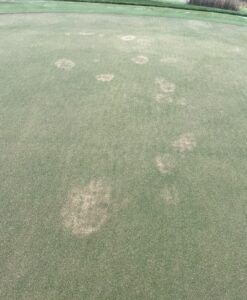
Anthracnose symptoms are highly variable, appearing yellow to orange in color
and in an irregular pattern, in small freckle-like spots, or in circular
patches up to 1’ in diameter. Symptoms are typically most severe in areas that
are stressed from low mowing, excessive traffic, or inadequate irrigation or
fertilization. On individual plants, symptoms first appear on the oldest
leaves, which die back from the tip, and gradually progress to the younger
leaves. Symptoms of anthracnose foliar blight will initially be limited to the
leaves, leaving the crowns, leaf sheaths and stolons healthy. In the case of
basal rot, the leaf sheaths, crowns, and stolons will be dark and rotten. The
anthracnose pathogen produces spores inside of structures called acervuli,
which are black, saucer-shaped pads with black spines (setae) protruding from
them. These can be seen on the infected leaves (foliar blight) or basal tissues
(basal rot) with a magnifying glass or small microscope.
|
anthracnose acervuli
|
Characteristic
|
Description
|
|
Host
Grass Species
|
creeping
bentgrass, annual bluegrass
|
|
Month(s)
with symptoms
|
May to
September
|
|
Stand
Symptoms
|
irregular
distribution across turf stand or patches (4 to 12 inches)
|
|
Foliar
Symptoms - Location/Shape
|
dieback
from leaf tip, blighting of entire leaves
|
|
Foliar
Symptoms - Color
|
yellow,
orange, tan, red
|
|
Root/Crown
Symptoms
|
none or
roots, stolons, rhizomes, and/or crowns dark brown or black
|
|
Fungal
Signs
|
acervuli
with setae
|
Note: Still not
sure if this is the right disease? The Turfgrass Disease
Identification program may be helpful. Or consult the experts at the Turf
Diagnostics Lab. Check the TurfFiles glossary for definitions
of unfamiliar terms.
FACTORS
AFFECTING DISEASE DEVELOPMENT
Anthracnose can occur virtually
year-round in North Carolina and many other parts of the country. In creeping
bentgrass putting greens, anthracnose basal rot is most active during hot
weather in the summer, whereas the foliar blight is most common during cool and
cloudy conditions. The opposite is true on annual bluegrass, with the basal rot
being most severe in cool, cloudy weather and the foliar blight more common
during hot, dry weather.
Anthracnose diseases are stress-induced.
Physiological stress from any source greatly encourages the development and
spread of the disease. In golf course putting greens, the most common culprits
are close mowing, drought stress, low fertility, excessive traffic, poor soil
drainage, or excessive thatch/organic matter accumulations.
Because of its sensitivity to
stress, annual bluegrass is much more susceptible to anthracnose than creeping
bentgrass, but creeping bentgrass varieties vary tremendously in their
susceptibility to anthracnose as well. Older varieties, such as Penncross,
Pennlinks, Dominant, Dominant Plus, L-93, and Crenshaw are susceptible to
anthracnose, whereas the disease is rarely observed on modern varieties such as
the Penn A and G series.
CULTURAL
CONTROL
Because annual bluegrass is most
susceptible to anthracnose, preventing this grassy weed from encroaching into
putting greens is an effective way to manage anthracnose. Conversion of putting
greens to newer, resistant varieties of creeping bentgrass will eliminate the
problem in most circumstances.
Avoiding or alleviating
physiological stress is another effective way to manage anthracnose. Raising
mowing heights prior to and during periods of disease activity have been shown
to reduce anthracnose development. Recent research at Rutgers University
demonstrated that anthracnose severity was greatest in annual bluegrass mowed
at 0.110”, less at 0.125”, and the least disease was observed at 0.150”. Golf
course superintendents should employ growth regulators and lightweight rollers
to increase putting speeds in lieu of low mowing heights. When using
sidewinder-type rollers, care must be taken to prevent scuffing and abrasion at
the end of each pass, as this injury may encourage anthracnose activity.
Adequate fertilization and
irrigation are also essential to anthracnose management. Deficiencies of any
essential plant nutrient will slow turf growth and increase anthracnose
development. Tissue samples should analyzed for nutrient content on a regular
basis to ensure that all nutrients are present in adequate amounts. Irrigation
should be applied frequently enough to prevent severe wilt and drought stress
during the day.
Regular aerification and
topdressing of putting greens is essential to preventing severe anthracnose
problems. As a general rule of thumb, 15% to 20% of the putting green surface
area should be impacted by hollow-tine aerification annually, and 5000 lbs/1000
ft2 of topdressing should be applied each year. Hollow-tine aeration
should be performed during cool weather conditions when the turf is growing
optimally. Solid-tining or spiking is recommended during stressful conditions
to provide temporary channels for air and water movement through the soil
profile. Topdressing applications during the summer should be light enough to
water-in, as the wounding caused by dragging or brooming operations can spread
the disease.
CHEMICAL
CONTROL
Successful control of anthracnose
with fungicides requires a preventative approach. Although the precise timing
of infection is unknown, the anthracnose pathogen likely infects turf plants
long before the symptoms appear. Where anthracnose has been a persistent
problem, a preventative fungicide program should be in place throughout the
growing season. In less severely affected sites, a preventative program should
be implemented prior to the onset of summer stress and during extended periods
of cool, cloudy weather.
The anthracnose pathogen can
become resistant to certain fungicides very quickly. In a recent survey of C.
cereale populations in North Carolina, all isolates were resistant to the
benzimidazole fungicides, and most exhibited some level of resistance to the
QoIs. Research at the University of California-Riverside has shown that DMI
resistance is developing slowly in anthracnose populations as well. Golf course
superintendents should tank-mix and rotate fungicide classes regularly to slow
the development of resistance and reduce their reliance on a single fungicide
chemistry.
|
Fungicide
|
Efficacy (1)
|
Resistance Risk (2)
|
Class (3)
|
Products (4)
|
|
chlorothalonil + propiconazole + fludioxonil**
|
++++
|
3
|
nitrile + DMI + phenylpyrolle
|
Instrata
|
|
azoxystrobin
|
++++
|
9
|
QoI
|
Heritage
|
|
fluoxastrobin
|
++++
|
9
|
QoI
|
Disarm
|
|
azoxystrobin + propiconazole
|
++++
|
9
|
QoI + DMI
|
Headway
|
|
thiophanate-methyl
|
+++
|
9
|
benzimidazole
|
3336, Fungo, Systec, T-Storm
|
|
flutolanil + thiophanate-methyl
|
+++
|
9
|
carboxamide + benzimidazole
|
SysStar
|
|
iprodione + thiophanate-methyl**
|
+++
|
9
|
dicarboxamide + benzimidazole
|
26/36, Fluid Fungicide
|
|
fenarimol**
|
+++
|
6
|
DMI
|
Rubigan
|
|
metconazole
|
+++
|
6
|
DMI
|
Tourney
|
|
myclobutanil
|
+++
|
6
|
DMI
|
Eagle
|
|
propiconazole
|
+++
|
6
|
DMI
|
Banner MAXX, Propiconazole G-Pro, Propiconazole Pro,
Quali-Pro Propiconazole, Savvi, Spectator
|
|
triticonazole
|
+++
|
6
|
DMI
|
Trinity, Triton
|
|
chlorothalonil**
|
+++
|
3
|
nitrile
|
Daconil, Chlorostar, Echo, Manicure
|
|
chlorothalonil + thiophanate-methyl**
|
+++
|
6
|
nitrile + benzimidazole
|
Spectro, ConSyst
|
|
chlorothalonil + propiconazole**
|
+++
|
4
|
nitrile + DMI
|
Concert
|
|
fludioxonil
|
+++
|
3
|
phenylpyrolle
|
Medallion
|
|
polyoxin D
|
+++
|
6
|
polyoxins
|
Endorse
|
|
pyraclostrobin
|
+++
|
9
|
QoI
|
Insignia
|
|
triadimefon
|
++
|
6
|
DMI
|
Bayleton
|
|
triadimefon + trifloxystrobin
|
++
|
9
|
DMI + QoI
|
Tartan, Armada
|
|
trifloxystrobin
|
++
|
9
|
QoI
|
Compass
|
|
** Not for application to
residential lawns.
|
|
Footnotes:
|
|
(1)
|
Efficacy Codes:
|
|
++++
|
excellent control when
conditions are highly favorable for disease development
|
|
+++
|
good control when disease
pressure is high, or excellent control when disease pressure is moderate
|
|
++
|
good control when disease
pressure is moderate, excellent control when disease pressure is low
|
|
+
|
good control when disease pressure
is low
|
|
0
|
does
not provide adequate control under any conditions
|
|
?
|
cannot be rated due to
insufficient data
|
|
(2)
|
Resistance Risk:
|
|
1
|
Rotating and tank-mixing not necessary,
but recommended to avoid potential side effects from continuous use of same
chemical class.
|
|
2
|
Rotate to different chemical
class after 3-4 applications; tank-mixing not necessary.
|
|
3
|
Rotate to different chemical class
after 2-3 applications; tank-mixing not necessary.
|
|
4
|
Rotate to different chemical
class after 1-2 applications; tank-mixing not necessary.
|
|
6
|
Rotate to different chemical
class after 1-2 applications; tank-mixing with low or moderate risk product
recommended.
|
|
9
|
Rotate to different chemical
class after EVERY application; tank-mix with low or moderate risk product for
EVERY application.
|
|
(3)
|
Continual use of fungicides
with similar control mechanisms (modes of action) can result in fungi that
are resistant to some chemicals. Poor or ineffective disease control can be
expected when this occurs. Managers can reduce the chances of this happening
by mixing or alternating fungicides belonging to different chemical classes.
|
|
(4)
|
Recommendations of specific
chemicals are based upon information on the manufacturer's label and
performance in a limited number of trials. Because environmental conditions and
methods of application may vary widely, performance of the chemical will not
always conform to the safety and pest control standards indicated by
experimental data. When more than one brand name exists for an agricultural
chemical, the name of brand that first came onto the market is listed first.
Otherwise, brand names are listed in alphabetical order. The order in which
brand names are given is not an indication of a recommendation or criticism.
|
|
Recommendations for the use of
agricultural chemicals are included in this publication as a convenience to
the reader. The use of brand names and any mention or listing of commercial
products or services does not imply endorsement by North Carolina State University or discrimination against similar products or services not mentioned. Other
brand names may be labeled for use on turfgrasses. Individuals who use
agricultural chemicals are responsible for ensuring that the intended use
complies with current regulations and conforms to the product label. Be sure
to obtain current information about usage regulations and examine a current
product label before applying any chemical. For assistance, contact your
county's Cooperative Extension agent.
|
© North Carolina
State University. This information sheet was prepared by Lane P. Tredway, Gail
G. Wilkerson, Bridget R. Lassiter, Jenifer J. Reynolds, and Gregory S. Buol.
Departments of Plant Pathology and Crop Science, College of Agriculture &
Life Sciences, North Carolina State University. Prepared March
23, 2009. Available on-line at www.turffiles.ncsu.edu. This publication was
made possible through a grant provided by the Center for Turfgrass
Environmental Research & Education (CENTERE) whose purpose is to support
worthwhile projects that will benefit both the private sector and the public,
and protect the environment.