|
|
Updating ...
COPPER SPOT
Copper Spot
[Gloeocercospora sorghi]
SYMPTOMS
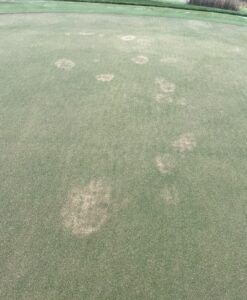
Copper spot is a disease of bentgrass species that develops during periods of warm and humid weather. Velvet bentgrass is particularly susceptible to the disease, but it is occasionally observed on creeping bentgrass as well. As the name implies, copper spot appears in small spots, usually less than 3 inches in diameter, that are copper or salmon in color. The disease causes a foliar blight, so distinct lesions or leaf spots are not evident on individual plants. When the turf is wet or humidity is high, the infected leaves may be covered with a thin, gelatinous coating of fungal spores.
Copper spot can often be confused with dollar spot, which produces very similar symptoms. These diseases can be easily distinguished early in the morning when dew is present on the turf. The dollar spot fungus produces white, cottony masses of mycelium on the infected turf, whereas copper spot produces gelatinous masses of spores that are copper or salmon in color. In addition, the outer margin of a copper spot is typically more diffuse than a dollar spot, which has very well defined edges.
|
copper spot |
Characteristic |
Description |
|
Host Grass Species |
creeping bentgrass, annual bluegrass |
|
Month(s) with symptoms |
April to September |
|
Stand Symptoms |
spots |
|
Foliar Symptoms - Location/Shape |
blighting of entire leaves |
|
Foliar Symptoms - Color |
tan, orange, red, pink |
|
Root/Crown Symptoms |
none |
|
Fungal Signs |
mycelium, jelly-like spore-masses |
Note: Still not sure if this is the right disease? The Turfgrass Disease Identification program may be helpful. Or consult the experts at the Turf Diagnostics Lab. Check the TurfFiles glossary for definitions of unfamiliar terms.
FACTORS AFFECTING DISEASE DEVELOPMENT
Copper spot develops during periods of warm, wet weather. The pathogen is most active when temperatures are between 65°F and 85°F. High humidity, frequent rainfall, or over-irrigation favors rapid infection and heavy sporulation. Unlike dollar spot, the development of copper spot is enhanced by excessive nitrogen levels. The disease is also more severe when soil pH is 5.5 or lower.
CULTURAL CONTROL
Avoid excessive nitrogen by using granular fertilizers with a blend of quick and slow release forms. In general, no more than 0.25 lb of water-soluble nitrogen should be applied to creeping bentgrass at any one time. Removal of dew in the morning by mowing, whipping, or dragging will shorten leaf wetness periods and discourage copper spot development. Practice deep and infrequent irrigation to minimize periods of leaf wetness. Prune or remove trees surrounding golf course putting greens to increase air movement and sunlight penetration. Installation of high-powered fans will also help to minimize copper spot development in areas where air movement is restricted. Creeping bentgrass performs best when soil pH is between 5.5 and 6.5, but pH should be maintained above 6.0 where annual bluegrass is being cultured. Annual soil testing should be used to determine if lime applications are needed to maintain soil pH in this optimal range.
CHEMICAL CONTROL
Little is known about the performance of fungicides for copper spot control. Where the disease has been a persistent problem, apply a labeled fungicide every 14 to 21 days when conditions are conducive to copper spot outbreaks. In other areas, the disease can be controlled curatively if it is detected early. Tank-mixtures of contact and systemic fungicides are most effective after copper spot symptoms appear.
|
Fungicide |
Efficacy (1) |
Resistance Risk (2) |
Class (3) |
Products (4) |
|
flutolanil + thiophanate-methyl |
+++ |
6 |
benzimidazole + carboxamide |
SysStar |
|
iprodione + thiophanate-methyl** |
+++ |
6 |
benzimidazole + dicarboxamide |
26/36, Dovetail, Fluid Fungicide |
|
chlorothalonil + thiophanate-methyl** |
+++ |
4 |
benzimidazole + nitrile |
Spectro, ConSyst, Peregrine, Tee-1-Up, TM/C |
|
triadimefon |
+++ |
4 |
DMI |
Bayleton, Granular Turf Fungicide, Systemic Fungicide |
|
triadimefon + trifloxystrobin |
+++ |
4 |
DMI + QoI |
Armada, Tartan |
|
mancozeb + myclobutanil** |
++ |
3 |
dithiocarbamate + DMI |
Manhandle |
|
mancozeb + copper hydroxide** |
++ |
2 |
dithiocarbamate + inorganic |
Junction |
|
chlorothalonil + propiconazole** |
++ |
2 |
DMI + nitrile |
Concert |
|
chlorothalonil + propiconazole + fludioxonil** |
++ |
2 |
DMI + nitrile + phenylpyrolle |
Instrata |
|
mancozeb** |
+ |
2 |
dithiocarbamate |
Fore, 4 Flowable Mancozeb, Dithane, Mancozeb DG, Pentathlon, Protect, Wingman |
|
thiram** |
+ |
2 |
dithiocarbamate |
Spotrete |
|
chlorothalonil** |
+ |
2 |
nitrile |
Daconil, Chlorostar, Chlorothalonil, Echo, Legend, Manicure, Pegasus |
|
chlorothalonil + fluoxastrobin** |
+ |
2 |
nitrile + QoI |
Disarm C |
|
thiophanate-methyl |
? |
6 |
benzimidazole |
3336, Fungo, Systec, T-Bird, T-Storm, Tee-Off, TM |
|
fenarimol** |
? |
4 |
DMI |
Rubigan |
|
myclobutanil |
? |
4 |
DMI |
Eagle, Myclobutanil |
|
propiconazole |
? |
4 |
DMI |
Banner MAXX, Kestrel, Kestrel MEX, ProPensity, Propiconazole, Propiconazole G-Pro, Propiconazole Pro, Savvi, Spectator, Strider |
|
tebuconazole** |
? |
4 |
DMI |
Torque |
|
triticonazole |
? |
4 |
DMI |
Trinity, Triton |
|
azoxystrobin + propiconazole |
? |
6 |
DMI + QoI |
Headway |
|
fluoxastrobin + myclobutanil |
? |
4 |
DMI + QoI |
Disarm M |
|
** Not for application to residential lawns. |
|
Footnotes: |
|
(1) |
Efficacy Codes: |
|
++++ |
excellent control when conditions are highly favorable for disease development |
|
+++ |
good control when disease pressure is high, or excellent control when disease pressure is moderate |
|
++ |
good control when disease pressure is moderate, excellent control when disease pressure is low |
|
+ |
good control when disease pressure is low |
|
0 |
does not provide adequate control under any conditions |
|
? |
cannot be rated due to insufficient data |
|
(2) |
Resistance Risk: |
|
1 |
Rotating and tank-mixing not necessary, but recommended to avoid potential side effects from continuous use of same chemical class. |
|
2 |
Rotate to different chemical class after 3-4 applications; tank-mixing not necessary. |
|
3 |
Rotate to different chemical class after 2-3 applications; tank-mixing not necessary. |
|
4 |
Rotate to different chemical class after 1-2 applications; tank-mixing not necessary. |
|
6 |
Rotate to different chemical class after 1-2 applications; tank-mixing with low or moderate risk product recommended. |
|
9 |
Rotate to different chemical class after EVERY application; tank-mix with low or moderate risk product for EVERY application. |
|
(3) |
Continual use of fungicides with similar control mechanisms (modes of action) can result in fungi that are resistant to some chemicals. Poor or ineffective disease control can be expected when this occurs. Managers can reduce the chances of this happening by mixing or alternating fungicides belonging to different chemical classes. |
|
(4) |
Recommendations of specific chemicals are based upon information on the manufacturer's label and performance in a limited number of trials. Because environmental conditions and methods of application may vary widely, performance of the chemical will not always conform to the safety and pest control standards indicated by experimental data. When more than one brand name exists for an agricultural chemical, the name of brand that first came onto the market is listed first. Otherwise, brand names are listed in alphabetical order. The order in which brand names are given is not an indication of a recommendation or criticism. |
|
Recommendations for the use of agricultural chemicals are included in this publication as a convenience to the reader. The use of brand names and any mention or listing of commercial products or services does not imply endorsement by North Carolina State University or discrimination against similar products or services not mentioned. Other brand names may be labeled for use on turfgrasses. Individuals who use agricultural chemicals are responsible for ensuring that the intended use complies with current regulations and conforms to the product label. Be sure to obtain current information about usage regulations and examine a current product label before applying any chemical. For assistance, contact your county's Cooperative Extension agent. |
© North Carolina State University. This information sheet was prepared by Lane P. Tredway, Gail G. Wilkerson, Bridget R. Lassiter, Jenifer J. Reynolds, and Gregory S. Buol. Departments of Plant Pathology and Crop Science, College of Agriculture & Life Sciences, North Carolina State University. Prepared March 7, 2011. Available on-line at www.turffiles.ncsu.edu. This publication was made possible through a grant provided by the Center for Turfgrass Environmental Research & Education (CENTERE) whose purpose is to support worthwhile projects that will benefit both the private sector and the public, and protect the environment.
KEYWORDS FOUND IN THIS ARTICLE:
|