Dollar Spot
[Sclerotinia
homoeocarpa]
SYMPTOMS
On
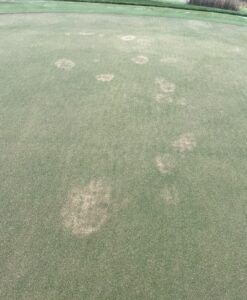
putting green turf, dollar spot appears as small spots, approximately the size of
a dollar coin, that are bleached-white or light tan in color. On turf mowed at
heights greater than 0.5”, the spots may expand in size up to 6” or more in
diameter. The affected leaves typically remain upright and are characterized by
having white or light-tan lesions with light reddish-brown margins. As the
lesions expand, the leaves are girdled and the upper part of the leaves dies
slowly. Distinct lesions are sometimes not evident on close-cut turfgrasses;
instead, the leaves die back from the tip and turn white or light tan in color.
The grass in the spots may be killed to the soil surface if the disease
continues to develop, and many spots may merge to produce large blighted areas.
Short, fuzzy white mycelium is often observed on affected turf in the morning
when dew is present.
|
dollar spot leaf lesions on Kentucky bluegrass
|
Characteristic
|
Description
|
|
Host
Grass Species
|
all
|
|
Month(s)
with symptoms
|
February
to November
|
|
Stand
Symptoms
|
spots,
patches (4 to 12 inches)
|
|
Foliar
Symptoms - Location/Shape
|
round
leaf spots, leaf lesions
|
|
Foliar
Symptoms - Color
|
tan or
white
|
|
Root/Crown
Symptoms
|
none
|
|
Fungal
Signs
|
mycelium
or none
|
Note: Still not
sure if this is the right disease? The Turfgrass Disease
Identification program may be helpful. Or consult the experts at the Turf
Diagnostics Lab. Check the TurfFiles glossary for definitions
of unfamiliar terms.
FACTORS
AFFECTING DISEASE DEVELOPMENT
Dollar spot
is most common in the spring and fall, when warm, humid days and cool nights
lead to heavy dew formation. Dollar spot may develop when night temperatures
exceed 50°F and the leaves are wet for 10 to 12 continuous hours. Extended
periods of wet, overcast weather can lead to severe dollar spot epidemics on
susceptible grasses. The disease can remain active throughout the summer, but
activity slows when daytime highs consistently exceed 90°F.
Turfgrasses that are deficient in
nutrients, especially nitrogen, are more prone to dollar spot and also recover
from the damage more slowly than well-fertilized turf. The disease is also
encouraged by drought stress, low mowing, excessive thatch accumulation,
frequent irrigation, and low air movement. Certain cultivars are very
susceptible to dollar spot while others are fairly tolerant.
CULTURAL
CONTROL
Use of
resistant cultivars is one of the most effective means of dollar spot
management. This is particularly important for creeping bentgrass and Kentucky
bluegrass, as cultivars vary widely in their susceptibility to the disease.
Base turfgrass selection on regional cultivar trials and University
recommendations, and plant blends and mixtures of cool-season grasses whenever
possible.
Adequate nitrogen fertilization
will help to prevent dollar spot, and will also encourage plants to recover
quickly from the disease if it occurs. Select nitrogen sources, rates, and
timings based on local University recommendations for your turfgrass species
and climate. Use soil test results to apply the recommended amounts of
phosphorus, potassium, lime, and micronutrients.
Dollar spot is encouraged by
drought stress and leaf wetness. Proper irrigation timing is needed to balance
these factors. Irrigate based on the moisture status of the soil, not on a
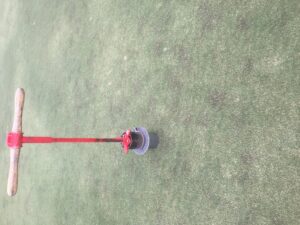
calendar schedule. Use a soil probe to monitor the amount of moisture in the
turfgrass root zone. Irrigate with sufficient water to wet the entire root
zone, and then repeat when the entire root zone is no longer moist. Irrigation
should be applied early in the morning, between midnight and 6 AM, to keep leaf
wetness periods as short as possible. Mowing, dragging, or whipping the turf in
the morning to remove dew can help to prevent dollar spot, but these practices
can spread the disease if it is actively developing. Improve air movement and
reduce humidity by pruning trees, clearing unwanted vegetation, or relocating
desirable plants.
Excessive thatch accumulations
greatly encourage dollar spot activity. Remove excess thatch by vertical mowing
or power raking. Golf course putting greens should be aerified regularly and
topdressed with sand to reduce thatch buildup.
Dollar spot is readily spread in
leaf tissue or clippings from infected areas. Avoid spreading the disease by
washing equipment before entering an uninfected area, by encouraging golfers to
clean their shoes between rounds, and by removing and disposing of clippings
taken from infected areas.
CHEMICAL
CONTROL
Many fungicides control dollar
spot, but preventative applications are most effective. A preventative program
should be implemented in the early spring when night temperatures consistently
exceed 50°F. When applied on a curative basis, fungicides must be applied at
high rates and short application intervals.
Uniform spray coverage is
important for maximizing fungicide performance; even small gaps in coverage may
allow dollar spot to develop. Nozzle type, nozzle pressure, and dilution rate
have the greatest impact on the uniformity of fungicide applications. Nozzles
that produce coarse to extremely coarse droplets, such as TurfJet or Raindrop
nozzles, dramatically reduce the performance of fungicides for dollar spot
control. Air-induction or flat fan nozzles that produce fine to medium droplets
are recommended. In order to provide thorough coverage of the turfgrass
foliage, fungicides should be applied in 2 gallons of water per 1000 ft2;
lower carrier volumes reduce the performance of fungicides for foliar disease
control.
The fungus that causes dollar
spot develops resistance to fungicides very quickly. To prevent or delay the
onset of fungicide resistance, use integrated management to minimize fungicide
use, rotate among fungicide classes after each application, and tank-mix
systemic fungicides with a contact fungicide.
|
Fungicide
|
Efficacy (1)
|
Resistance Risk (2)
|
Class (3)
|
Products (4)
|
|
thiophanate-methyl
|
++++
|
9
|
benzimidazole
|
3336, Fungo, Systec, T-Storm
|
|
boscalid**
|
++++
|
9
|
carboxamide
|
Emerald
|
|
vinclozolin**
|
++++
|
6
|
dicarboxamide
|
Curalan, Touche
|
|
myclobutanil
|
++++
|
6
|
DMI
|
Eagle
|
|
propiconazole
|
++++
|
6
|
DMI
|
Banner MAXX, Propiconazole G-Pro, Propiconazole Pro,
Quali-Pro Propiconazole, Savvi, Spectator
|
|
triadimefon
|
++++
|
6
|
DMI
|
Bayleton
|
|
triticonazole
|
++++
|
6
|
DMI
|
Trinity
|
|
iprodione**
|
+++
|
6
|
dicarboxamide
|
26GT, Iprodione Pro
|
|
fenarimol**
|
+++
|
6
|
DMI
|
Rubigan
|
|
chlorothalonil**
|
+++
|
3
|
nitrile
|
Daconil, Chlorostar, Echo, Manicure
|
|
pyraclostrobin
|
++
|
9
|
QoI
|
Insignia
|
|
mancozeb**
|
+
|
3
|
dithiocarbamate
|
Fore, Dithane, Protect
|
|
maneb**
|
+
|
3
|
dithiocarbamate
|
Pentathlon
|
|
thiram**
|
+
|
3
|
dithiocarbamate
|
Spotrete
|
|
trifloxystrobin
|
+
|
9
|
QoI
|
Compass
|
|
** Not for application to
residential lawns.
|
|
Footnotes:
|
|
(1)
|
Efficacy Codes:
|
|
|
++++
|
excellent control when
conditions are highly favorable for disease development
|
|
|
+++
|
good control when disease
pressure is high, or excellent control when disease pressure is moderate
|
|
|
++
|
good control when disease
pressure is moderate, excellent control when disease pressure is low
|
|
|
+
|
good control when disease
pressure is low
|
|
|
0
|
does
not provide adequate control under any conditions
|
|
|
?
|
cannot be rated due to
insufficient data
|
|
(2)
|
Resistance Risk:
|
|
|
1
|
Rotating and tank-mixing not necessary,
but recommended to avoid potential side effects from continuous use of same
chemical class.
|
|
|
2
|
Rotate to different chemical
class after 3-4 applications; tank-mixing not necessary.
|
|
|
3
|
Rotate to different chemical class
after 2-3 applications; tank-mixing not necessary.
|
|
|
4
|
Rotate to different chemical
class after 1-2 applications; tank-mixing not necessary.
|
|
|
6
|
Rotate to different chemical
class after 1-2 applications; tank-mixing with low or moderate risk product
recommended.
|
|
|
9
|
Rotate to different chemical
class after EVERY application; tank-mix with low or moderate risk product for
EVERY application.
|
|
(3)
|
Continual use of fungicides with
similar control mechanisms (modes of action) can result in fungi that are
resistant to some chemicals. Poor or ineffective disease control can be
expected when this occurs. Managers can reduce the chances of this happening
by mixing or alternating fungicides belonging to different chemical classes.
|
|
(4)
|
Recommendations of specific
chemicals are based upon information on the manufacturer's label and
performance in a limited number of trials. Because environmental conditions
and methods of application may vary widely, performance of the chemical will
not always conform to the safety and pest control standards indicated by
experimental data. When more than one brand name exists for an agricultural
chemical, the name of brand that first came onto the market is listed first.
Otherwise, brand names are listed in alphabetical order. The order in which
brand names are given is not an indication of a recommendation or criticism.
|
|
|
Recommendations for the use of agricultural
chemicals are included in this publication as a convenience to the reader.
The use of brand names and any mention or listing of commercial products or
services does not imply endorsement by North Carolina State University or
discrimination against similar products or services not mentioned. Other
brand names may be labeled for use on turfgrasses. Individuals who use
agricultural chemicals are responsible for ensuring that the intended use
complies with current regulations and conforms to the product label. Be sure
to obtain current information about usage regulations and examine a current
product label before applying any chemical. For assistance, contact your
county's Cooperative Extension agent.
|
© North Carolina State University. This information sheet was prepared
by Lane P. Tredway, Gail G. Wilkerson, Bridget R. Lassiter, Jenifer J.
Reynolds, and Gregory S. Buol. Departments of Plant Pathology and Crop Science,
College of Agriculture & Life Sciences, North Carolina State University.
Prepared April 29, 2008. Available on-line at
www.turffiles.ncsu.edu. This publication was made possible through a grant
provided by the Center for Turfgrass Environmental Research & Education
(CENTERE) whose purpose is to support worthwhile projects that will benefit
both the private sector and the public, and protect the environment.