|
|
Updating ...
GRAY LEAF SPOT
Gray Leaf Spot
[Pyricularia grisea]
SYMPTOMS
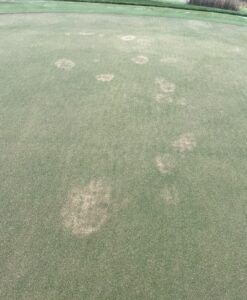
Gray leaf spot initially appears as spots on the leaves that are round or oval, tan in color, and have a dark brown border. When the leaves are wet or humidity is high, the leaf spots turn gray and fuzzy with profuse spore production. In time, the leaf spots expand and girdle the leaf, causing it to die back from the tip. Significant damage to the turf stand may occur as the disease continues to progress. In tall fescue and perennial ryegrass, foliar blighting initially occurs in patches from 6 to 12 inches in diameter that are orange to yellow in color. Like the leaf spots, these patches rapidly coalesce to produce large, irregular areas of damaged turf. The leaves of tall fescue and perennial ryegrass blighted by gray leaf spot are typically matted and greasy in appearance. Because of this symptom, gray leaf spot is often confused with Pythium blight in tall fescue and perennial ryegrass. Gray leaf spot does not develop in distinct patches in St. Augustinegrass, but affected leaves may wither and die, causing a brown cast to the turf that is visible from a distance.
|
gray leaf spot on tall fescue |
Characteristic |
Description |
|
Host Grass Species |
tall fescue, perennial ryegrass, and St. Augustinegrass |
|
Month(s) with symptoms |
July, August, September |
|
Stand Symptoms |
spots, patches (4 to 12 inches) |
|
Foliar Symptoms - Location/Shape |
round or oval leaf spots |
|
Foliar Symptoms - Color |
tan, gray |
|
Root/Crown Symptoms |
none |
|
Fungal Signs |
none or fuzzy spore masses |
Note: Still not sure if this is the right disease? The Turfgrass Disease Identification program may be helpful. Or consult the experts at the Turf Diagnostics Lab. Check the TurfFiles glossary for definitions of unfamiliar terms.
FACTORS AFFECTING DISEASE DEVELOPMENT
Gray leaf spot is most severe in newly established turfgrass stands. The disease is typically most severe in the first year of establishment, but then gradually becomes less damaging as the turf matures.
Turfgrass hosts vary widely in their susceptibility to damage from gray leaf spot. Perennial ryegrass is most rapidly affected by the disease, with widespread turf loss occurring in a period of a few days. St. Augustinegrass is most resistant, and rarely sustains significant damage if properly managed. Tall fescue has an intermediate level of resistance to gray leaf spot. In St. Augustinegrass, gray leaf spot is most active from June through August. In tall fescue and perennial ryegrass, most cases of the disease appear from late July through September.
Gray leaf spot may develop when temperatures are between 70 and 95°F, but the fungus also requires at least 14 hours of continuous leaf wetness in order to initiate infection. Any factor that increases the amount of leaf wetness will increase gray leaf spot development. Lush leaf tissue produced by turf that is fertilized with excessive nitrogen is extremely prone to infection by the gray leaf spot pathogen.
CULTURAL CONTROL
Cultivars of tall fescue and St. Augustinegrass vary considerably in gray leaf spot susceptibility. Perennial ryegrass cultivars with resistance to gray leaf spot are starting to become available. Refer to the results of cultivar evaluation trials operated by the National Turfgrass Evaluation Program or local Universities for cultivars with gray leaf spot resistance that perform well in your area.
Managing leaf wetness is an effective means for minimizing gray leaf spot in all hosts. Use the Turf Irrigation Management System available on TurfFiles to schedule irrigation based on weather conditions and turf needs. Schedule irrigation early in the morning, before sunrise, and never in the late afternoon or evening. Prune or remove trees, shrubs, or other barriers to increase air movement and sunlight penetration.
Proper mowing practices are most important for gray leaf spot management in St. Augustinegrass. This grass must be mowed frequently during the summer months to remove excess leaf tissue, keep the canopy open and dry, and remove developing gray leaf spot lesions. Collecting clippings reduces spread of the disease when gray leaf spot symptoms are evident. Apply nitrogen and other nutrients as recommended to maintain vigorous foliar growth during the summer months. Excessive shade, in addition to promoting leaf wetness, slows St. Augustinegrass growth and enhances gray leaf spot problems.
Stress of any kind will encourage gray leaf spot development in tall fescue and perennial ryegrass. Proper mowing, fertilization, and irrigation practices will reduce the chances of significant turf loss from this disease. Mow to recommended heights, using the “1/3 rule” as a guide for mowing frequency. Collect clippings when gray leaf spot is active to reduce further spread of the disease. Do not apply nitrogen to susceptible grasses in late spring or summer. When establishing a new stand of tall fescue or perennial ryegrass, use recommended seeding rates to encourage rapid maturation of new seedlings.
CHEMICAL CONTROL
Since perennial ryegrass can sustain serious damage in a short period of time, preventative fungicide applications are recommended for gray leaf spot control. A preventative program should be initiated in mid-June or early-July in most locations, with repeat applications on a 14 to 21 day interval. Tall fescue should be monitored frequently for gray leaf spot development so that fungicides can be applied to stop epidemic development. Fungicides are usually not necessary for gray leaf spot control in St. Augustinegrass if the turf is properly maintained.
|
Fungicide |
Efficacy (1) |
Resistance Risk (2) |
Class (3) |
Products (4) |
|
thiophanate-methyl |
++++ |
9 |
benzimidazole |
3336, Fungo, Systec, T-Bird, T-Storm, Tee-Off, TM |
|
flutolanil + thiophanate-methyl |
++++ |
9 |
benzimidazole + carboxamide |
SysStar |
|
iprodione + thiophanate-methyl** |
++++ |
9 |
benzimidazole + dicarboxamide |
26/36, Dovetail, Fluid Fungicide |
|
chlorothalonil + thiophanate-methyl** |
++++ |
6 |
benzimidazole + nitrile |
Spectro, ConSyst, Peregrine, Tee-1-Up, TM/C |
|
azoxystrobin + propiconazole |
++++ |
9 |
DMI + QoI |
Headway |
|
azoxystrobin |
++++ |
9 |
QoI |
Heritage |
|
fluoxastrobin |
++++ |
9 |
QoI |
Disarm, Disarm G |
|
pyraclostrobin |
+++ |
9 |
QoI |
Insignia |
|
mancozeb** |
++ |
3 |
dithiocarbamate |
Fore, 4 Flowable Mancozeb, Dithane, Mancozeb DG, Pentathlon, Protect, Wingman |
|
mancozeb + myclobutanil** |
++ |
3 |
dithiocarbamate + DMI |
Manhandle |
|
mancozeb + copper hydroxide** |
++ |
3 |
dithiocarbamate + inorganic |
Junction |
|
metconazole |
++ |
6 |
DMI |
Tourney |
|
propiconazole |
++ |
6 |
DMI |
Banner MAXX, Kestrel, Kestrel MEX, ProPensity, Propiconazole, Propiconazole G-Pro, Propiconazole Pro, Savvi, Spectator, Strider |
|
chlorothalonil + propiconazole** |
++ |
4 |
DMI + nitrile |
Concert |
|
chlorothalonil + propiconazole + fludioxonil** |
++ |
4 |
DMI + nitrile + phenylpyrolle |
Instrata |
|
triadimefon + trifloxystrobin |
++ |
9 |
DMI + QoI |
Armada, Tartan |
|
chlorothalonil** |
++ |
3 |
nitrile |
Daconil, Chlorostar, Chlorothalonil, Echo, Legend, Manicure, Pegasus |
|
trifloxystrobin |
++ |
9 |
QoI |
Compass |
|
tebuconazole** |
? |
6 |
DMI |
Torque |
|
triticonazole |
? |
6 |
DMI |
Trinity, Triton |
|
polyoxin D |
? |
6 |
polyoxins |
Endorse, Affirm |
|
** Not for application to residential lawns. |
|
Footnotes: |
|
(1) |
Efficacy Codes: |
|
++++ |
excellent control when conditions are highly favorable for disease development |
|
+++ |
good control when disease pressure is high, or excellent control when disease pressure is moderate |
|
++ |
good control when disease pressure is moderate, excellent control when disease pressure is low |
|
+ |
good control when disease pressure is low |
|
0 |
does not provide adequate control under any conditions |
|
? |
cannot be rated due to insufficient data |
|
(2) |
Resistance Risk: |
|
1 |
Rotating and tank-mixing not necessary, but recommended to avoid potential side effects from continuous use of same chemical class. |
|
2 |
Rotate to different chemical class after 3-4 applications; tank-mixing not necessary. |
|
3 |
Rotate to different chemical class after 2-3 applications; tank-mixing not necessary. |
|
4 |
Rotate to different chemical class after 1-2 applications; tank-mixing not necessary. |
|
6 |
Rotate to different chemical class after 1-2 applications; tank-mixing with low or moderate risk product recommended. |
|
9 |
Rotate to different chemical class after EVERY application; tank-mix with low or moderate risk product for EVERY application. |
|
(3) |
Continual use of fungicides with similar control mechanisms (modes of action) can result in fungi that are resistant to some chemicals. Poor or ineffective disease control can be expected when this occurs. Managers can reduce the chances of this happening by mixing or alternating fungicides belonging to different chemical classes. |
|
(4) |
Recommendations of specific chemicals are based upon information on the manufacturer's label and performance in a limited number of trials. Because environmental conditions and methods of application may vary widely, performance of the chemical will not always conform to the safety and pest control standards indicated by experimental data. When more than one brand name exists for an agricultural chemical, the name of brand that first came onto the market is listed first. Otherwise, brand names are listed in alphabetical order. The order in which brand names are given is not an indication of a recommendation or criticism. |
|
Recommendations for the use of agricultural chemicals are included in this publication as a convenience to the reader. The use of brand names and any mention or listing of commercial products or services does not imply endorsement by North Carolina State University or discrimination against similar products or services not mentioned. Other brand names may be labeled for use on turfgrasses. Individuals who use agricultural chemicals are responsible for ensuring that the intended use complies with current regulations and conforms to the product label. Be sure to obtain current information about usage regulations and examine a current product label before applying any chemical. For assistance, contact your county's Cooperative Extension agent. |
© North Carolina State University. This information sheet was prepared by Lane P. Tredway, Gail G. Wilkerson, Bridget R. Lassiter, Jenifer J. Reynolds, and Gregory S. Buol. Departments of Plant Pathology and Crop Science, College of Agriculture & Life Sciences, North Carolina State University. Prepared March 7, 2011. Available on-line at www.turffiles.ncsu.edu. This publication was made possible through a grant provided by the Center for Turfgrass Environmental Research & Education (CENTERE) whose purpose is to support worthwhile projects that will benefit both the private sector and the public, and protect the environment.
KEYWORDS FOUND IN THIS ARTICLE:
|