Large Patch
[Rhizoctonia
solani]
SYMPTOMS
Large
patch is a new name for an old disease. This disease was formerly called brown
patch, the same disease that affects cool-season grasses during hot weather.
Other than the fact that they affect different grasses, there are several
important differences between brown patch and large patch that necessitated a
name change: they occur at different times of the year, produce distinct
symptoms, are caused by different strains of the fungus Rhizoctonia solani,
and require very different control strategies.
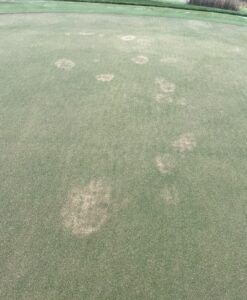
Large patch appears in roughly
circular patches that are yellow, tan, or straw-brown. The patches are
initially 2 to 3 feet in diameter, but can expand in size rapidly up to 10 feet
or more in diameter, hence the name “large patch”. Multiple patches may
coalesce to encompass even larger areas of turf. When the disease is actively developing,
the outer edge of the patches are often red, orange, or bronze in color. Close
examination of individual plants reveals the presence of reddish-brown or gray
lesions on the leaf sheaths. It may be necessary to peel away the older, dead
leaves in order to reveal the lesions on the younger leaf sheaths below.
|
large patch sheath lesion in St. Augustinegrass
|
Characteristic
|
Description
|
|
Host
Grass Species
|
bermudagrass,
centipedegrass, St. Augustinegrass, zoysiagrass
|
|
Month(s)
with symptoms
|
August
to May
|
|
Stand
Symptoms
|
patches
(1 foot to greater than 3 feet)
|
|
Foliar
Symptoms - Location/Shape
|
lesions
on leaf sheaths
|
|
Foliar
Symptoms - Color
|
tan,
yellow, orange, red
|
|
Root/Crown
Symptoms
|
none
|
|
Fungal
Signs
|
none
|
Note: Still not
sure if this is the right disease? The Turfgrass Disease
Identification program may be helpful. Or consult the experts at the Turf
Diagnostics Lab. Check the TurfFiles glossary for definitions
of unfamiliar terms.
FACTORS
AFFECTING DISEASE DEVELOPMENT
Large patch
begins to develop when soil temperatures decline to 70°F in the fall, but the
symptoms do not necessarily appear at this time. The symptoms of large patch
are most evident during periods of cool, wet weather in the fall and spring. In
many cases, symptoms may not become evident until early spring when the warm season
grasses are greening up.
Large patch is favored by
excessive nitrogen in the fall and spring, poor soil drainage, over-irrigation,
excessive thatch accumulations, and low mowing heights. Centipedegrass is most
susceptible to large patch, followed by zoysiagrass, and then St.
Augustinegrass. Bermudagrass, rarely affected by large patch, recovers very
quickly when the disease does occur.
CULTURAL
CONTROL
Establishment
of a disease-resistant turfgrass species is the most effective means for
management of large patch. Bermudagrass rarely sustains significant damage from
large patch, and grows of out the symptoms quickly when the disease does occur.
In contrast, centipedegrass, St. Augustinegrass, and zoysiagrass often sustain
serious damage and recovery can take several weeks or months. Fescues and
bluegrasses are immune to large patch and are also an option in areas where
cool-season turfgrasses can be maintained.
Do not apply nitrogen to
warm-season grasses in the fall and spring. These grasses are growing slowly
during this time and do not require a significant amount of this nutrient. In
general, nitrogen should not be applied to the warm-season grasses within 6
weeks before dormancy in the fall or within 3 weeks after green-up in the
spring. Warm-season grasses vary in their fertility requirements, so refer to
local University recommendations for more specific recommendations for timing
and rates.
Avoid establishing warm-season
grasses in low lying areas that remain saturated for extended periods of time
from surface runoff. If this is necessary, install subsurface drainage to
remove excess water from the soil. Irrigate only as needed to prevent severe
drought stress in the fall and spring. Control traffic patterns to prevent
severe compaction, and aerify as needed to maintain soil drainage and aeration.
Mow at recommended heights, and power rake or vertical mow as needed to control
thatch accumulations.
CHEMICAL
CONTROL
Fungicides are available for
large patch control, but must be applied on a preventative basis. Applications
should be initiated in the fall when soil temperatures decline to 70°F,
regardless of when symptoms have appeared in the past. One or two well-timed
applications provide season-long control of large patch in many situations. In
severely affected sites, repeat applications should be made on 4 to 6 week
intervals as long as soil temperatures are between 40°F and 70°F. Mapping of
affected areas in the spring for spot-treatment in the fall can substantially
reduce fungicide expenditures.
|
Fungicide
|
Efficacy (1)
|
Resistance Risk (2)
|
Class (3)
|
Products (4)
|
|
flutolanil
|
++++
|
4
|
carboxamide
|
ProStar
|
|
triadimefon
|
++++
|
4
|
DMI
|
Bayleton
|
|
azoxystrobin
|
++++
|
6
|
QoI
|
Heritage
|
|
propiconazole
|
+++
|
4
|
DMI
|
Banner MAXX, Propiconazole G-Pro, Propiconazole Pro,
Quali-Pro Propiconazole, Savvi, Spectator
|
|
iprodione**
|
++
|
4
|
dicarboxamide
|
26GT, Iprodione Pro
|
|
myclobutanil
|
++
|
4
|
DMI
|
Eagle
|
|
triticonazole
|
?
|
4
|
DMI
|
Trinity
|
|
polyoxin D
|
?
|
4
|
polyoxins
|
Endorse
|
|
fluoxastrobin
|
?
|
6
|
QoI
|
Disarm
|
|
** Not for application to
residential lawns.
|
|
Footnotes:
|
|
(1)
|
Efficacy Codes:
|
|
|
++++
|
excellent control when
conditions are highly favorable for disease development
|
|
|
+++
|
good control when disease
pressure is high, or excellent control when disease pressure is moderate
|
|
|
++
|
good control when disease
pressure is moderate, excellent control when disease pressure is low
|
|
|
+
|
good control when disease
pressure is low
|
|
|
0
|
does
not provide adequate control under any conditions
|
|
|
?
|
cannot be rated due to
insufficient data
|
|
(2)
|
Resistance Risk:
|
|
|
1
|
Rotating and tank-mixing not necessary,
but recommended to avoid potential side effects from continuous use of same
chemical class.
|
|
|
2
|
Rotate to different chemical
class after 3-4 applications; tank-mixing not necessary.
|
|
|
3
|
Rotate to different chemical class
after 2-3 applications; tank-mixing not necessary.
|
|
|
4
|
Rotate to different chemical
class after 1-2 applications; tank-mixing not necessary.
|
|
|
6
|
Rotate to different chemical
class after 1-2 applications; tank-mixing with low or moderate risk product
recommended.
|
|
|
9
|
Rotate to different chemical
class after EVERY application; tank-mix with low or moderate risk product for
EVERY application.
|
|
(3)
|
Continual use of fungicides
with similar control mechanisms (modes of action) can result in fungi that
are resistant to some chemicals. Poor or ineffective disease control can be
expected when this occurs. Managers can reduce the chances of this happening
by mixing or alternating fungicides belonging to different chemical classes.
|
|
(4)
|
Recommendations of specific
chemicals are based upon information on the manufacturer's label and
performance in a limited number of trials. Because environmental conditions
and methods of application may vary widely, performance of the chemical will
not always conform to the safety and pest control standards indicated by
experimental data. When more than one brand name exists for an agricultural
chemical, the name of brand that first came onto the market is listed first.
Otherwise, brand names are listed in alphabetical order. The order in which
brand names are given is not an indication of a recommendation or criticism.
|
|
|
Recommendations for the use of agricultural
chemicals are included in this publication as a convenience to the reader.
The use of brand names and any mention or listing of commercial products or
services does not imply endorsement by North Carolina State University or
discrimination against similar products or services not mentioned. Other
brand names may be labeled for use on turfgrasses. Individuals who use
agricultural chemicals are responsible for ensuring that the intended use
complies with current regulations and conforms to the product label. Be sure
to obtain current information about usage regulations and examine a current
product label before applying any chemical. For assistance, contact your
county's Cooperative Extension agent.
|
© North Carolina State University. This information sheet was prepared
by Lane P. Tredway, Gail G. Wilkerson, Bridget R. Lassiter, Jenifer J.
Reynolds, and Gregory S. Buol. Departments of Plant Pathology and Crop Science,
College of Agriculture & Life Sciences, North Carolina State University.
Prepared April 29, 2008. Available on-line at
www.turffiles.ncsu.edu. This publication was made possible through a grant
provided by the Center for Turfgrass Environmental Research & Education
(CENTERE) whose purpose is to support worthwhile projects that will benefit
both the private sector and the public, and protect the environment.