Microdochium Patch (Pink Snow Mold)
[Microdochium
nivale]
SYMPTOMS
Pink snow
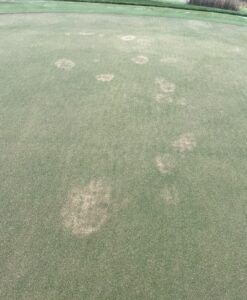
mold develops during periods of snow cover, with symptoms of the disease
becoming evident as the snow melts. The disease appears in roughly circular
patches from 2 inches to 1 foot in diameter that are white or light tan in
color. A ring of salmon or pink-colored growth is present on the outer edge of
patches when the disease is actively developing. The infected leaves within the
patches are usually collapsed and matted down upon themselves.
Microdochium nivale may
also infect turfgrasses in the absence of snow cover during periods of cool,
wet weather; in these cases, the disease is referred to as Microdochium
patch. The symptoms of Microdochium patch are slightly different than
pink snow mold. The patches are similar to pink snow mold in size and shape,
but are reddish-brown or salmon-colored and greasy in appearance. When the
disease is actively developing, the patches may be surrounded by a dark brown
or bronze ring.
|
Microdochium patch
|
Characteristic
|
Description
|
|
Host
Grass Species
|
bentgrass,
bermudagrass, bluegrasses
|
|
Month(s)
with symptoms
|
November
to March
|
|
Stand
Symptoms
|
spots,
circles, patches (4 to 12 inches)
|
|
Foliar
Symptoms - Location/Shape
|
blighting
of entire leaves
|
|
Foliar
Symptoms - Color
|
pink,
white, tan
|
|
Root/Crown
Symptoms
|
none
|
|
Fungal
Signs
|
mycelium,
jelly-like spore-masses
|
Note: Still not
sure if this is the right disease? The Turfgrass Disease
Identification program may be helpful. Or consult the experts at the Turf
Diagnostics Lab. Check the TurfFiles glossary for definitions
of unfamiliar terms.
FACTORS
AFFECTING DISEASE DEVELOPMENT
Disease activity is most severe
when snow falls on unfrozen ground; however, activity can occur without snow
cover during cool (less than 60°F) wet weather. Excessive foliar growth and
thatch buildup are the most important factors encouraging development of pink
snow mold and Microdochium patch. Restricted air movement, poor soil
drainage, inadequate levels of potassium, and heavy traffic can also enhance
the disease. The disease may also develop under tree leaves that remain on the
turf for long periods during cold, wet weather.
CULTURAL
CONTROL
Do not apply nitrogen when cold
weather is expected or before the first expected prolonged snow cover. Continue
mowing in the fall until foliar growth stops completely. These steps will
prevent a buildup of lush foliage that is highly prone to pink snow mold or Microdochium
patch.
Apply a high-potassium fertilizer
in late fall to increase the cold hardiness of the turf. Improve surface
drainage, control traffic patterns, reduce thatch accumulations, and aerify
regularly in areas that have been severely affected by the disease in the past.
Prune trees and remove unwanted vegetation that impedes air movement.
Frequently remove leaves and other debris during autumn and winter from turf
that is not covered with snow.
In regions where heavy snow is
anticipated, take steps to minimize the duration of snow cover. Erect snow
fences or plant landscape plants in strategic locations to prevent excess snow
accumulation. Prevent traffic on snow-covered turf, as compacted snow will melt
more slowly and increase damage from pink snow mold.
CHEMICAL
CONTROL
Fungicides are effective for
control of pink snow mold and Microdochium patch. In the case of pink
snow mold, apply fungicides before snow cover to prevent disease development.
Mapping and spot-treatment of areas where pink snow mold is most severe can
significantly reduce fungicide expenditures. In regions where prolonged snow
cover does not occur, apply fungicides when symptoms of Microdochium
patch are first observed.
|
Fungicide
|
Efficacy (1)
|
Resistance Risk (2)
|
Class (3)
|
Products (4)
|
|
quintozene
|
++++
|
2
|
aromatic hydrocarbon
|
PCNB, Terraclor, Turfcide
|
|
chlorothalonil + propiconazole + fludioxonil**
|
++++
|
2
|
nitrile + DMI + phenylpyrolle
|
Instrata
|
|
fludioxonil
|
++++
|
2
|
phenylpyrolle
|
Medallion
|
|
thiophanate-methyl
|
+++
|
6
|
benzimidazole
|
3336, Fungo, Systec, T-Storm
|
|
flutolanil + thiophanate-methyl
|
+++
|
6
|
carboxamide + benzimidazole
|
SysStar
|
|
iprodione**
|
+++
|
4
|
dicarboxamide
|
26GT, Iprodione Pro
|
|
iprodione + thiophanate-methyl**
|
+++
|
6
|
dicarboxamide + benzimidazole
|
26/36
|
|
propiconazole
|
+++
|
4
|
DMI
|
Banner MAXX, Propiconazole G-Pro, Propiconazole Pro,
Quali-Pro Propiconazole, Savvi, Spectator
|
|
triadimefon + trifloxystrobin
|
+++
|
6
|
DMI + QoI
|
Tartan, Armada
|
|
chlorothalonil + thiophanate-methyl**
|
+++
|
4
|
nitrile + benzimidazole
|
Spectro, ConSyst
|
|
polyoxin D
|
+++
|
4
|
polyoxins
|
Endorse
|
|
trifloxystrobin
|
+++
|
6
|
QoI
|
Compass
|
|
azoxystrobin + propiconazole
|
+++
|
6
|
QoI + DMI
|
Headway
|
|
vinclozolin**
|
++
|
4
|
dicarboxamide
|
Curalan, Touche
|
|
fenarimol**
|
++
|
4
|
DMI
|
Rubigan
|
|
myclobutanil
|
++
|
4
|
DMI
|
Eagle
|
|
triadimefon
|
++
|
4
|
DMI
|
Bayleton
|
|
chlorothalonil**
|
++
|
2
|
nitrile
|
Daconil, Chlorostar, Echo, Manicure
|
|
azoxystrobin
|
++
|
6
|
QoI
|
Heritage
|
|
mancozeb**
|
+
|
2
|
dithiocarbamate
|
Fore, Dithane, Pentathlon, Protect
|
|
mancozeb + copper hydroxide**
|
+
|
2
|
dithiocarbamate
|
Junction
|
|
thiram**
|
+
|
2
|
dithiocarbamate
|
Spotrete
|
|
metconazole
|
?
|
4
|
DMI
|
Tourney
|
|
triticonazole
|
?
|
4
|
DMI
|
Trinity, Triton
|
|
fluoxastrobin
|
?
|
6
|
QoI
|
Disarm
|
|
** Not for application to
residential lawns.
|
|
Footnotes:
|
|
(1)
|
Efficacy Codes:
|
|
++++
|
excellent control when
conditions are highly favorable for disease development
|
|
+++
|
good control when disease
pressure is high, or excellent control when disease pressure is moderate
|
|
++
|
good control when disease pressure
is moderate, excellent control when disease pressure is low
|
|
+
|
good control when disease
pressure is low
|
|
0
|
does
not provide adequate control under any conditions
|
|
?
|
cannot be rated due to
insufficient data
|
|
(2)
|
Resistance Risk:
|
|
1
|
Rotating and tank-mixing not
necessary, but recommended to avoid potential side effects from continuous
use of same chemical class.
|
|
2
|
Rotate to different chemical
class after 3-4 applications; tank-mixing not necessary.
|
|
3
|
Rotate to different chemical
class after 2-3 applications; tank-mixing not necessary.
|
|
4
|
Rotate to different chemical
class after 1-2 applications; tank-mixing not necessary.
|
|
6
|
Rotate to different chemical class
after 1-2 applications; tank-mixing with low or moderate risk product
recommended.
|
|
9
|
Rotate to different chemical
class after EVERY application; tank-mix with low or moderate risk product for
EVERY application.
|
|
(3)
|
Continual use of fungicides
with similar control mechanisms (modes of action) can result in fungi that
are resistant to some chemicals. Poor or ineffective disease control can be
expected when this occurs. Managers can reduce the chances of this happening by
mixing or alternating fungicides belonging to different chemical classes.
|
|
(4)
|
Recommendations of specific
chemicals are based upon information on the manufacturer's label and performance
in a limited number of trials. Because environmental conditions and methods
of application may vary widely, performance of the chemical will not always
conform to the safety and pest control standards indicated by experimental
data. When more than one brand name exists for an agricultural chemical, the
name of brand that first came onto the market is listed first. Otherwise,
brand names are listed in alphabetical order. The order in which brand names
are given is not an indication of a recommendation or criticism.
|
|
Recommendations for the use of
agricultural chemicals are included in this publication as a convenience to
the reader. The use of brand names and any mention or listing of commercial
products or services does not imply endorsement by North Carolina State University or discrimination against similar products or services not mentioned. Other
brand names may be labeled for use on turfgrasses. Individuals who use
agricultural chemicals are responsible for ensuring that the intended use
complies with current regulations and conforms to the product label. Be sure
to obtain current information about usage regulations and examine a current
product label before applying any chemical. For assistance, contact your
county's Cooperative Extension agent.
|
© North Carolina
State University. This information sheet was prepared by Lane P. Tredway, Gail
G. Wilkerson, Bridget R. Lassiter, Jenifer J. Reynolds, and Gregory S. Buol.
Departments of Plant Pathology and Crop Science, College of Agriculture &
Life Sciences, North Carolina State University. Prepared March
23, 2009. Available on-line at www.turffiles.ncsu.edu. This publication was
made possible through a grant provided by the Center for Turfgrass
Environmental Research & Education (CENTERE) whose purpose is to support
worthwhile projects that will benefit both the private sector and the public,
and protect the environment.