March
through May
June through August
September through November
December through February
More About Centipedegrass
Disclaimer
Home Lawn Calendar
This calendar of suggested management practices
is designed to assist you in the seasonal care of your lawn. Location, terrain, soil type and
condition, age of the lawn, previous lawn care, and other factors affect turf performance. For
these reasons, tile following management practices and dates should be adjusted
to suit your particular home lawn conditions.
March through May
Mowing
Mow lawn at 1 inch at time of initial greenup. Mow before grass gets above 1 1/2 inches tall. Do not burn off centipedegrass to remove excessive debris because of possible injury to the lawn and potential fire hazard.
Fertilization
DO NOT apply nitrogen at this time. Yellow
appearance may be an indication of iron deficiency. Spray iron (ferrous) sulfate (2 ounces in
water per 1,000 sq. ft.) or a chelated iron source to enhance color as needed. Follow label
directions.
Watering
Water to prevent drought stress. About 1 inch of
water per application each week is needed for growing centipedegrass. Sandy soils often require
more frequent watering; i.e., 1/2 inch of water every third day. Proper irrigation may
prevent or reduce pest and nonpest problems from occurring later in the summer.
Weed Control
Apply preemergence herbicides to control crabgrass,
goosegrass, and foxtail. Apply by the time that dogwoods are in full bloom. Apply postemergence
herbicides in May as needed for control of summer annual and perennial broadleaf weeds such as
knotweed, spurge, lespedeza, etc. Do not apply until 3 weeks after greenup. Centipedegrass is
sensitive to certain herbicides (e.g. 2,4-D), so follow label directions and use with caution.
Insect Control
Check for white grubs and control if necessary.
(See White Grubs in Turf, ENT/ORT-67, AG-366)
Thatch
Power rake (vertical mow) to remove thatch (layer of undecayed grass) in late May if necessary. A 2- or 3-inch blade spacing set 1/4-inch deep in one direction works best. Do not use a power rake with a 1-inch blade spacing as severe turf injury may result.
Renovation
Replant large bare areas in May using seed (1/4 to 1/2 pound per 1,000 sq. ft.) or sprigs (3/4 bushel per 1,000 sq. ft.). Mixing seed with 2 gallons of fine sand per 1,000 sq. ft. will aid in distribution. Germination is expected in 28 days but establishment is slow. Keep seedbed continually moist with light, frequent sprinklings several times a day to ensure good germination. Three years for complete establishment of a new lawn is not uncommon. (See North Carolina Cooperative Extension Service Publication
Carolina
Lawns, AG-69.)
Return to Main Index
Mowing
Mow lawn at 1 inch. Mow before grass gets above 1 1/2 inches tall.
Fertilization
Fertilize with 1/2 pound of nitrogen per
1,000 sq. ft. (once a year) in mid-June using a high potassium fertilizer (e.g., 5-5-15, 6-6-12,
8-8-24). An additional fertilization in August may enhance performance
in coastal locations. Fertilizers without phosphorus (e.g., 15-0-14, 8-0-24) are preferred
if soils exhibit moderate-to-high levels of phosphorus. Yellow appearance may
indicate an iron deficiency. Spray iron (ferrous) sulfate (2 ounces in water
per 1,000 sq. ft.) or a chelated iron source to enhance color as needed. Follow
label directions.
To determine amount of product required to apply
1/2 pound of nitrogen per 1,000 sq. ft., divide 50 by the FIRST number on the
fertilizer bag. Example: A 5-5-15 fertilizer. Dividing 50 by 5 = 10 pounds of
product to be applied per 1,000 sq. ft. for 1/2 pound of nitrogen.
Watering
Water to prevent drought stress. About 1 inch of
water per application each week is needed for growing centipedegrass. Sandy soils often
require more frequent watering; i.e., l/2 inch of water every third day.
Weed Control
Apply postemergence herbicides as needed for
control of summer annual and perennial broadleaf weeds, such as knotweed, spurge, lespedeza,
etc. Centipedegrass is sensitive to certain herbicides (e.g., 2,4-D, MSMA), so
follow label directions and use with caution. Do not apply herbicides unless
grass and weeds are actively growing and lawn is not suffering from drought
stress.
Insect Control
Check for white grubs and control if necessary. (See North Carolina Cooperative Extension Service Publication White Grubs in Turf, ENT/ORT-67, AG-366.)
Disease Control
Have soil assayed if nematode damage is suspected. Contact your county Extension Center for assistance.
Return to Main Index
September through November
Mowing
Mow lawn at 1 inch. Mow before grass gets
above 1 1/2 inches tall. Raise mowing height to 1 1/2 inches several weeks before expected
frost.
Fertilization
Fertilize with 1 pound of potash (K2O)
per 1,000 sq. ft. 4 to 6 weeks before expected frost using 1.6 pounds of muriate of potash
(0-0-60) or 2 pounds of potassium sulfate (0-0-50). DO NOT lime
centipedegrass unless recommended by soil test.
To determine amount of product required to apply
1 pound of potash per 1,000 sq. ft., divide 100 by the THIRD number on the
fertilizer bag. Example: A 6-6-12 fertilizer. Dividing 100 by 12 = 8.3 pounds
of product to be applied per 1,000 sq. ft. for 1 pound of potassium.
Watering
Water to prevent drought stress. About 1 inch
of water per application each week is sufficient for growing centipedegrass. Sandy soils often
require more frequent watering; i.e., 1/2 inch of water every third day. Water following
onset of dormancy (browning of foliage) if needed to prevent excessive dehydration.
Insect Control
Check for white grubs and control if necessary. (See North Carolina Cooperative Extension Service Publication White Grubs in Turf, ENT/ORT-67, AG-366.)
Return to Main Index
December through February
Mowing
Remove lawn debris (rocks, sticks, and leaves). Do not burn off centipedegrass to remove excessive debris because of possible injury to the grass and potential fire hazard.
Fertilization
DO NOT fertilize centipedegrass at this time.
Submit soil samples for analysis every 3 years to determine nutrient requirements. Be sure to
specify centipedegrass. (Contact your county Extension Center for details.) Apply lime
or sulfur if suggested (based on soil test) to raise or reduce soil pH
respectively. DO NOT lime centipedegrass unless recommended by soil test.
Watering
Water to prevent excessive dehydration.
Weed Control
Apply broadleaf herbicides as necessary for
control of chickweed, henbit, etc. Centipedegrass is sensitive to certain herbicides
(e.g., 2,4-D), so follow label directions for reducing rates, and use with caution. Selected
herbicides (e.g., atrazine or simazine) can be applied in November or December for control
of annual bluegrass (Poa annua) and several winter annual broadleaf
weeds.
Return to Main Index
More About Centipedegrass
Centipedegrass is a slow-growing, apple-green, coarse-leafed turfgrass that is adapted for use as a low maintenance, general purpose turf. It requires little fertilizer (l/2 pound of nitrogen per 1,000 sq. ft. per year), infrequent mowing, and grows well in full sun to moderate shade. It does not tolerate traffic, compaction, high-phosphorus soils, high pH, low-potassium soils, excessive thatch, drought, or heavy shade.
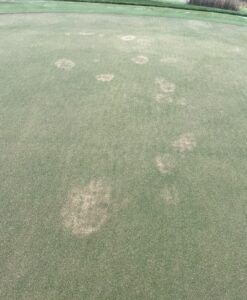
Centipedegrass is susceptible to a number of pest-related problems. Symptoms include small circular dead areas after several years of good performance. Areas do not green up in the spring or begin to die in late spring or during drought stress. Grass at the edge of affected areas may yellow, wilt, and die. Possible causes include nematodes, ground pearls (an insect), and fairy ring (a disease). Nematode damage appears as weak areas invaded by weeds. If nematodes are suspected, submit a soil sample for analysis. (See Plant Pathology Information Note 241, Problems on Centipedegrass, for details.) Ground pearls appear as circular dead areas with only weeds growing in the center. (See Department of Entomology Insect Note No. 64, Ground Pearls.) Fairy rings appear as circular green or dead areas that continue to enlarge for several years. (See Extension Service publication Diseases of
Warm-Season Grasses, AG-360.) Injury from certain broadleaf weed control herbicides and mismanagement can also display these symptoms. Following proper lawn management practices, as discussed in this publication, is the best means of preventing and controlling centipedegrass problems. Continual loss of centipedegrass may indicate the need to choose another grass species. Contact your county Extension Center for assistance if needed.
Maintenance programs provided by professional lawn care service companies may differ from recommendations given here yet be equally effective.
Return to Main Index
DISCLAIMER:
Recommendations for the use of agricultural chemicals are included in this
publication as a convenience to the reader. The use of brand names and any
mention or listing of commercial products or services in this publication does
not imply endorsement by the North Carolina Cooperative Extension Service nor
discrimination against similar products or services not mentioned. Individuals
who use agricultural chemicals are responsible for ensuring that the intended
use complies with current regulations and conforms to the product label. Be
sure to obtain current information about usage regulations and examine a
current product label before applying any chemical. For assistance, contact
your county Cooperative Extension Service agent.
Prepared by Arthur H. Bruneau, Crop Science Extension Specialist, Turfgrass,
with contributions and assistance from the following:
Matthew C. Martin, Area Specialized Agent, Turfgrass
Henry C. Wetzel, Extension Plant Pathology Specialist, Turfgrass
Rick L. Brandenburg, Extension Entomologist
Fred H. Yelverton, Extension Crop Science Specialist, Weed Management
Cale A. Bigelow, Extension Associate, Turfgrass
Published by North Carolina Cooperative Extension Service
Publication Number: AG-381 Revised: December 2000
This Electronic Revision: Sept, 2007
This publication is available on
the TurfFiles Web site at http://www.turffiles.ncsu.edu/.