|

Diseases
of Turfgrasses on Athletic Fields in North Carolina
Turfgrass Disease Information Note 3 (TGIN-003)
Henry C. Wetzel III, Extension Plant Pathologist
A number of diseases can cause serious damage to
turfgrasses on athletic fields in North Carolina. Many of the problems are caused by fungi
and nematodes, but other problems are caused by management and/or environmental factors.
An accurate diagnosis is the first and most important factor in the control of turfgrass
diseases.
Soil compaction is probably the most serious
problem on athletic fields and causes poor growth of turfgrasses. Compaction results from
traffic such as practicing, playing or marching on the fields. Limiting access for the use
of athletic fields must be a part of a good turf management program. Proper oxygen
and water relations in the soil for turfgrasses are disrupted by the soil particles being
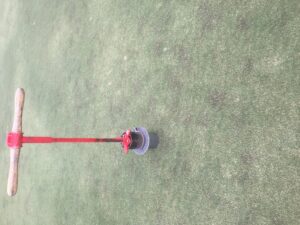
pressed together. The soil should be loosened by renovating or aerifying to relieve the
compaction for better growth of turfgrasses. Allieviating soil compaction will
reduce the severity of all the turfgrass diseases mentioned in this information note.
Diseases of the commonly used cool
season turfgrasses (tall fescue, Kentucky
bluegrass, and perennial ryegrass) and the
warm season turfgrass (bermudagrass) used
in North Carolina are described. The cool season grasses are used mostly
as permanent turf in the mountain regions and ryegrasses are sometimes
used to overseed bermudagrass in eastern regions of the state. The more
cold tolerant bermudagrass cultivars such as Vamont and Midlawn are used
in the northern regions of the Piedmont, which are also more tolerant
to the disease spring dead spot.
Tall
Fescue Diseases
Brown patch is the most serious disease of
tall fescue. The early symptoms of this disease are small circular brown patches about 1
foot in diameter that develop during hot-wet weather. More patches develop and the older
patches may continue to enlarge up to 4 to 6 feet in diameter during hot weather. Lesions
that are olive color in the morning when dew is present, or during rainy weather, develop
rapidly on young leaves. As the tissue dries the lesions become very light tan. Lesions
may girdle leaves causing the portion above the lesion to die. Webby mycelium of the
fungus may be seen on the lesions and the surrounding grass blades in the morning or
during extended periods of humid and cloudy weather in the summer. Vigorously growing
plants that have received higher than recommended rates of nitrogen fertilizer during the
spring are more susceptible to the disease. Tall fescue established less than one year can
be completely killed by this disease. Affected areas may need renovating to correct soil
pH and fertility problems and replanting in September or October. Well-established fields
may be damaged during the summer months, but with proper maintenance (proper soil pH, low
nitrogen levels in the summer, infrequent irrigation, regular mowing when the grass is
dry, and fall fertilization) the grass will usually recover during the fall. Fungicides
such as Daconil Ultrex, Chipco 26GT, Consyst, Spectro, Bannar MAXX, Eagle, Compass,
Heritage or Prostar applied once every 2 weeks during favorable weather conditions for
disease development will give good control of brown patch. Fungicide treatments are
necessary if day time temperatures are in the mid to upper 80's, evening temperatures are
greater than 68 degrees F and rainfall or irrigation events are occurring regularly to
reduce disease severity in tall fescue.
Helminthosporium net blotch
occurs on tall fescue but usually does not cause severe damage. The symptoms
of this disease are dark brown "net" patterns on the leaves.
Young seedlings may be killed by the disease, but old plants will usually
overcome the damage during favorable growing periods.
Rust occurs on tall fescue and is seen most
often in late summer. The symptoms of rust on tall fescue are small yellow spots on leaves
with masses of yellow to rust colored microscopic spores in the center of the spots. The
number of spots may become so numerous that the entire leaf becomes yellow and dies
slowly. The turf will recover from rust during favorable growing conditions.
Maintaining a balanced fertility program and preventing drought stress will reduce rust
severity.
Drought and heat during the summer can
damage tall fescue. Seedlings that are less than one year old may be killed by drought.
Old tall fescue plants may go dormant during dry weather in summer and turn yellow or
brown. Many of these plants will resume growth during cooler weather when adequate
moisture is present. Young tall fescue fields need irrigating during hot-dry weather.
Older, well established fescue will remain greener with irrigation. In both cases,
irrigate infrequently (once every week during dry weather) and enough water should be
applied to wet the soil at least 6 inches deep. A good fertility program to
encourage the development of a healthy root system in the fall and spring will help tall
fescue tolerate hot and dry weather.
Kentucky
Bluegrass Diseases
Helminthosporium leaf
spot occurs frequently on Kentucky bluegrass. The leaf spot symptoms
are small dark spots on the leaves that increase in number and size and
cause the leaves to die. Leaf spots develop in the spring and often continue
to develop throughout the summer and fall. The disease will cause a brown
color and will reduce the vigor of the turf. Some of the fungi that cause
leaf spots cause root and crown rots that result in melting-out or fading-out
in the summer. Broad spectrum fungicides such as Daconil Ultrex, or Chipco
26GT can be used to control these diseases in the spring before leaf spot
symptoms become severe. Good management programs that avoid excessive
rates of nitrogen and use of irrigation infrequently, but enough each
time to wet the soil 6 inches deep to prevent water stress will help prevent
damage from Helminthosporium diseases on Kentucky bluegrass.
Some of the new Kentucky bluegrass varieties have more resistance to these
diseases and should be used Consult the results of the national
Turfgrass Variety Trials (http://www.ntep.org) for this information.
Red thread is a common disease on Kentucky
bluegrass in the mountains during the summer. The symptoms of the disease are small
circular brown areas 0.5 to 1 foot in diameter. The symptoms are very similar to brown
patch that sometimes develops on Kentucky bluegrass. Red thread can be identified by the
presence of a small "red threads" of the fungus that causes the disease at the
tip of many of the dead leaves. Small amounts of nitrogen fertilizer can be used to
stimulate Kentucky bluegrass to overcome the disease. Some fungicides can be used to
control the disease, including Heritage, Compass, Prostar, Banner MAXX, Bayleton, Rubigon,
Chipco 26 GT or Daconil Ultrex.
Rust is a serious disease on some Kentucky
bluegrass varieties. The symptoms of rust are small yellow or brown spots on leaves that
enlarge and increase in number until entire leaves are affected. Masses of orange to rust
colored microscopic spores develop on the lesions. Affected leaves die slowly giving the
turf a yellow to brown appearance. The turf will usually become thin and may be more
susceptible to other diseases and weed invasion. If a white cloth is rubbed on the
affected turf, a rusty color which are the spores will be present on the cloth. Broad
spectrum fungicides can be used, but the best control is the use of improved varieties and
good management programs, including balanced fertility and to prevent drought stress.
Southern blight is a disease that occurs on
Kentucky bluegrass in the mountains of North Carolina. The symptoms of this disease are
dead circular areas 0.5 to 3 feet in diameter that usually have a tuft of green grass in
the center. The disease develops rapidly during hot and wet weather. Even clover and other
weeds in the affected spots are usually killed by the fungus. White masses of the fungus
and small yellow sclerotia of the fungus are usually present near the soil surface at the
advancing edge of the spots. Kentucky Bluegrass usually spreads back into the spots with
good management.
Dollar spot sometimes occurs
on Kentucky bluegrass and appears as small circular to hour-glass
lesions 2 to 4 inches in diameter. A cottony growth may be present in
the morning on leaves in affected spots. Good management practices and
the use of small amounts of nitrogen will help overcome the effects of
this disease.
Perennial
Ryegrass Diseases
Diseases discussed under tall fescue
and Kentucky bluegrass such as brown patch, red thread, Helminthosporium
diseases, dollar spot, and rust occur on perennial ryegrasses with similar
symptoms. Some perennial ryegrass cultivars are very susceptible to rust.
Pythium blight and brown patch are often serious problems on perennial
ryegrass used to overseed bermudagrass in eastern North Carolina. Symptoms
of Pythium blight are rapid death of seedlings in circular to oblong areas
during warm-wet weather. Sometimes gray masses of the fungus may be present
in the affected areas giving the condition called cottony blight. Planting
perennial ryegrass in the fall when the weather is cooler will help avoid
damage from these diseases. Also, treatment of seeds before or soon after
planting with certain fungicides, such as Subdue or Koban will give good
control. Proper watering will help prevent these diseases and improve
seedling survival.
Bermudagrass
Diseases
Spring dead spot is a serious disease of
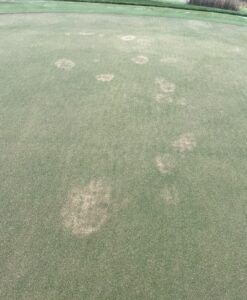
common and hybrid bermudagrass on some athletic fields. Symptoms of this disease are small
circular dead spots 0.5 to 2 feet in diameter in the spring as bermudagrass resumes growth
from winter dormancy. This disease usually develops in 4 to 6 years old bermudagrass that
has been managed at a high level. Bermudagrass grows over the spots slowly, or weeds
invade the affected spots, during the summer. The spots may occur in the same place and
enlarge for 2 or 3 years and then disappear. Factors associated with development of this
disease are high rates of nitrogen fertilizer and accumulation of excess thatch. An
application of the fungicide Rubigan, at 6 oz per 1000 sq. in September to turf that was
affected in the spring, has given good control of this disease the following spring.
Management practices that use lower rates of nitrogen and thatch removal will help prevent
spring dead spot. Avoid late-summer/early-fall nitrogen applications since this will
aggrevate this disease. Applications of one pound per 1000 ft sq. of potassium
chloride or potassium sulfate on monthly intervals during the fall months have reduced the
severity of this disease.
Nematodes which are microscopic eel-like
worms in the soil, can cause serious damage on bermudagrass, especially in sandy soils in
southeastern North Carolina. Several nematodes including sting, ring, stunt, lance,
stubby-root, and spiral nematodes are commonly found in soil from bermudagrass turf.
Serious damage to bermudagrass has been associated with the sting nematode. The symptoms
of damage by the sting nematode are poor turf that does not respond quickly to nitrogen
fertilizer and wilts quickly during dry weather. Turfgrass may appear very chlorotic in
the spring where nematodes are active. The roots are stunted and very shallow.
Nematicides will control the sting nematode, however, nematicides are highly toxic and
must be applied by certified pesticide applicators. A good management program that
includes fertilizer and irrigation to prevent drought stress will help bermudagrass
overcome the effect of these nematodes.
Dollar spot is sometimes a problem on
bermudagrass turf in late summer. Symptoms of this disease are small brown spots 1 to 3
inches in diameter. The spots may become so numerous that the turf has a general brown
appearance. The disease usually develops on bermudagrass turf that has not been fertilized
adequately with nitrogen. The use of good management practices including proper amounts of
nitrogen and water will help bermudagrass overcome this disease.
Fairy rings cause dead, dark green, or a
combination of dead and dark green rings in turf from a few to many feet in diameter.
Mushrooms may be present in the dead or green rings at certain times of the year.
Sometimes fairy rings occur as rings of mushrooms without any apparent effects on the
turfgrass. The rings occur in the same area for a number of years and enlarge a few inches
or feet each year. The fairy ring fungi grow in the soil and cause the green rings by
releasing nitrogen from organic matter, or kill the grass by releasing toxins into the
soil or preventing water from entering the soil. The fungi usually begin growing on some
source of organic matter such as old stumps buried in the soil. Removal of soil from
affected rings and replacement with clean soil and replanting with healthy grass is
recommended, but is usually not practical. Rototilling the soil in and around the rings
and replanting healthy grass has controlled fairy rings in some cases. Loosening of the
soil and watering the area frequently may help control some fairy rings. Grasses that
spread rapidly such as bermudagrass often will spread into the affected areas whereas
grasses such as tall fescue may be killed and areas fill in with weeds.
Algae are single celled plants that grow on
the surface of wet soils. Algae may appear as a black slimy growth on the surface of a
poorly drained soil in wet weather and may crack and curl when the soil becomes dry. It is
usually a problem in an area that does not drain properly and may have a low soil pH.
Algae can be controlled by correcting soil drainage and soil nutrient problems.
Diagnosis
and Management of Diseases
Diseases and other problems can
be diagnosed by using the descriptions given in this and other publications.
Assistance in identification and control recommendations can be obtained
from your local Agricultural Extension agent. Soil samples should be taken
regularly to identify nutritional and nematode problems. Pesticide and
fertilizer suggestions are updated annually in the N. C. Agricultural
Chemicals Manual, which would be a good reference. Many different diseases
and problems occur on turfgrasses in North Carolina because of the diverse
climatic regions in the state. The selection of the best turfgrass and
proper management program will help prevent and overcome many of the diseases.
Other Links
Plant
Disease Information Notes Home Page
North
Carolina Insect Notes
North
Carolina Agricultural Chemicals Manual
CALS
Home Page
NCCES
Home Page
NCARS
Home Page
For assistance with
a specific problem, contact your local North
Carolina Cooperative Extension Service
[Top of Page]
Published by North
Carolina Cooperative Extension Service. Distributed in furtherance of
the Acts of Congress of May 8 and June 30, 1914. Employment and program
opportunities are offered to all people regardless of race, color, national
origin, sex, age, or disability. North Carolina State University at Raleigh,
North Carolina A&T State University, U.S. Department of Agriculture,
and local governments cooperating.
Reformatted Dec. 2000 by Plant Disease and Insect Clinic
|