|
|
Updating ...
MELTING OUT
Leaf Spot / Melting Out
[Drechslera poae & Bipolaris cynodontis]
SYMPTOMS
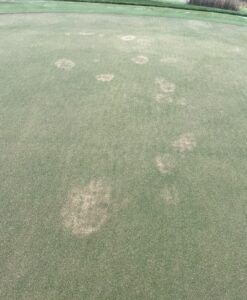
Leaf spot and melting out are common diseases in bluegrasses and bermudagrasses caused by species of Drechslera and Bipolaris (formerly known as Helminthosporium). In the bluegrasses, this disease is most active during warm and humid weather, but in bermudagrasses, most damage occurs during cool and wet periods in the fall and spring. Leaf spot symptoms are expressed in the early stages of the disease, but if left uncontrolled, the pathogen may progress into the basal portions of the plant to cause �melting out�. Leaf spot symptoms initially appear as small, brown or black spots or flecks on the leaves or sheaths. As the lesions expand, the center of the lesions becomes tan with a dark brown or black border. The lesions may also be surrounded by a yellow halo. As the lesions expand, they coalesce and cause dieback of entire leaves or plants. Melting out symptoms appear as a reddish brown rotting of the sheaths, crowns, rhizomes, or stolons which initially leads to wilting, yellowing, or death of the foliage. Symptoms of leaf spot and melting out appear in irregular patterns, although localized �hot spots� may be more severely damaged than others.
|
leaf spot/melting out in bermudagrass |
Characteristic |
Description |
|
Host Grass Species |
bluegrasses, bermudagrass |
|
Month(s) with symptoms |
March to June, Sept to November |
|
Stand Symptoms |
irregular distribution across turf stand |
|
Foliar Symptoms - Location/Shape |
oval leaf spots |
|
Foliar Symptoms - Color |
yellow, tan, brown |
|
Root/Crown Symptoms |
none |
|
Fungal Signs |
none |
Note: Still not sure if this is the right disease? The Turfgrass Disease Identification program may be helpful. Or consult the experts at the Turf Diagnostics Lab. Check the TurfFiles glossary for definitions of unfamiliar terms.
FACTORS AFFECTING DISEASE DEVELOPMENT
Leaf spot/melting out is one of several Helminthosporium diseases which survive in thatch during periods that are unfavorable for disease development. These fungi are most active during periods of cool (60 to 65�F) and wet weather, but some are able to cause disease whenever temperatures are above freezing.
Leaf spot/melting out is most severe on turf that is growing slowly due to adverse weather conditions or improper management practices. Shaded areas with little or no air movement result in weak turf and extended periods of leaf wetness that favor disease development. Deficient or excessive nitrogen, excessive thatch, extended periods of leaf wetness, drought stress, and low mowing heights are factors that encourage the development of Helminthosporium diseases. These fungi may spread to the crowns and roots and cause melting out, which is most severe during periods of hot weather.
Certain cultivars of turfgrasses are very susceptible to injury from Helminthosporium diseases while many of the newly released cultivars have exhibited good resistance.
CULTURAL CONTROL
Use turfgrass cultivars with resistance to this disease when available. Planting resistant cultivars is one of the most effective and economical ways to manage leaf spot and melting out. Refer to the results of cultivar evaluation trials operated by the National Turfgrass Evaluation Program or local Universities for cultivars with leaf spot resistance that perform well in your area. If planting cool-season turf, use blends and mixtures of multiple species and/or varieties when possible..
Fertilize to meet the nutritional needs of the turf but avoid over-stimulation and the development of lush, succulent growth. Do not apply more than one pound of nitrogen per 1,000 square feet in a single application. Mowing heights and frequencies should be within the recommended range for the turfgrass species being managed. Keep the mower blades sharp to prevent open wounds through which the fungus can enter.
Reduce extended periods of leaf wetness by watering deeply but infrequently to wet the entire root zone. Use the Turf Irrigation Management System available on TurfFiles to schedule irrigation based on weather conditions and turf needs. Do not irrigate just before or after sunrise, and ensure good surface and soil drainage. Remove unwanted vegetation that impedes air movement and prune trees to allow for light penetration. Power rake or dethatch to remove excessive thatch and reduce the potential for pathogen survival. Regular aerification and topdressing of golf greens is also necessary to reduce thatch buildup.
CHEMICAL CONTROL
Leaf spot can be controlled on a preventative or curative basis. However, applications are most effective when made in the early stages of development. Once the disease reaches the melting out stage, fungicides may not cure infected plants but will help to reduce further spread of the disease. Susceptible turfs should be monitored frequently for signs of disease activity during periods of cool and wet weather.
|
Fungicide |
Efficacy (1) |
Resistance Risk (2) |
Class (3) |
Products (4) |
|
iprodione + thiophanate-methyl** |
++++ |
6 |
benzimidazole + dicarboxamide |
26/36, Dovetail, Fluid Fungicide |
|
iprodione** |
++++ |
4 |
dicarboxamide |
26/36, IPro, Iprodione Pro, Raven |
|
vinclozolin** |
++++ |
4 |
dicarboxamide |
Curalan, Touche |
|
mancozeb** |
++++ |
2 |
dithiocarbamate |
Fore, 4 Flowable Mancozeb, Dithane, Mancozeb DG, Pentathlon, Protect, Wingman |
|
mancozeb + myclobutanil** |
++++ |
3 |
dithiocarbamate + DMI |
Manhandle |
|
mancozeb + copper hydroxide** |
++++ |
2 |
dithiocarbamate + inorganic |
Junction |
|
azoxystrobin + propiconazole |
++++ |
6 |
DMI + QoI |
Headway |
|
azoxystrobin |
++++ |
6 |
QoI |
Heritage |
|
chlorothalonil + thiophanate-methyl** |
+++ |
4 |
benzimidazole + nitrile |
Spectro, ConSyst, Peregrine, Tee-1-Up, TM/C |
|
pyraclostrobin + boscalid** |
+++ |
6 |
carboxamide + QoI |
Honor |
|
chlorothalonil + propiconazole** |
+++ |
3 |
DMI + nitrile |
Concert |
|
chlorothalonil + propiconazole + fludioxonil** |
+++ |
2 |
DMI + nitrile + phenylpyrolle |
Instrata |
|
chlorothalonil** |
+++ |
2 |
nitrile |
Daconil, Chlorostar, Chlorothalonil, Echo, Legend, Manicure, Pegasus |
|
chlorothalonil + phosphorous acid** |
+++ |
4 |
nitrile + phosphonate |
Vitalonil |
|
pyraclostrobin |
+++ |
6 |
QoI |
Insignia |
|
thiram** |
++ |
2 |
dithiocarbamate |
Spotrete |
|
propiconazole |
++ |
4 |
DMI |
Banner MAXX, Kestrel, Kestrel MEX, ProPensity, Propiconazole, Propiconazole G-Pro, Propiconazole Pro, Savvi, Spectator, Strider |
|
mineral oil** |
++ |
2 |
hydrocarbon |
Civitas |
|
myclobutanil |
+ |
4 |
DMI |
Eagle, Myclobutanil |
|
thiophanate-methyl |
? |
6 |
benzimidazole |
3336, Fungo, Systec, T-Bird, T-Storm, Tee-Off, TM |
|
flutolanil + thiophanate-methyl |
? |
6 |
benzimidazole + carboxamide |
SysStar |
|
tebuconazole** |
? |
4 |
DMI |
Torque |
|
triticonazole |
? |
4 |
DMI |
Trinity, Triton |
|
fluoxastrobin + myclobutanil |
? |
6 |
DMI + QoI |
Disarm M |
|
triadimefon + trifloxystrobin |
? |
6 |
DMI + QoI |
Armada, Tartan |
|
chlorothalonil + fluoxastrobin** |
? |
6 |
nitrile + QoI |
Disarm C |
|
fludioxonil |
? |
2 |
phenylpyrolle |
Medallion |
|
fluoxastrobin |
? |
6 |
QoI |
Disarm, Disarm G |
|
trifloxystrobin |
? |
6 |
QoI |
Compass |
|
** Not for application to residential lawns. |
|
Footnotes: |
|
(1) |
Efficacy Codes: |
|
++++ |
excellent control when conditions are highly favorable for disease development |
|
+++ |
good control when disease pressure is high, or excellent control when disease pressure is moderate |
|
++ |
good control when disease pressure is moderate, excellent control when disease pressure is low |
|
+ |
good control when disease pressure is low |
|
0 |
does not provide adequate control under any conditions |
|
? |
cannot be rated due to insufficient data |
|
(2) |
Resistance Risk: |
|
1 |
Rotating and tank-mixing not necessary, but recommended to avoid potential side effects from continuous use of same chemical class. |
|
2 |
Rotate to different chemical class after 3-4 applications; tank-mixing not necessary. |
|
3 |
Rotate to different chemical class after 2-3 applications; tank-mixing not necessary. |
|
4 |
Rotate to different chemical class after 1-2 applications; tank-mixing not necessary. |
|
6 |
Rotate to different chemical class after 1-2 applications; tank-mixing with low or moderate risk product recommended. |
|
9 |
Rotate to different chemical class after EVERY application; tank-mix with low or moderate risk product for EVERY application. |
|
(3) |
Continual use of fungicides with similar control mechanisms (modes of action) can result in fungi that are resistant to some chemicals. Poor or ineffective disease control can be expected when this occurs. Managers can reduce the chances of this happening by mixing or alternating fungicides belonging to different chemical classes. |
|
(4) |
Recommendations of specific chemicals are based upon information on the manufacturer's label and performance in a limited number of trials. Because environmental conditions and methods of application may vary widely, performance of the chemical will not always conform to the safety and pest control standards indicated by experimental data. When more than one brand name exists for an agricultural chemical, the name of brand that first came onto the market is listed first. Otherwise, brand names are listed in alphabetical order. The order in which brand names are given is not an indication of a recommendation or criticism. |
|
Recommendations for the use of agricultural chemicals are included in this publication as a convenience to the reader. The use of brand names and any mention or listing of commercial products or services does not imply endorsement by North Carolina State University or discrimination against similar products or services not mentioned. Other brand names may be labeled for use on turfgrasses. Individuals who use agricultural chemicals are responsible for ensuring that the intended use complies with current regulations and conforms to the product label. Be sure to obtain current information about usage regulations and examine a current product label before applying any chemical. For assistance, contact your county's Cooperative Extension agent. |
� North Carolina State University. This information sheet was prepared by Lane P. Tredway, Gail G. Wilkerson, Bridget R. Lassiter, Jenifer J. Reynolds, and Gregory S. Buol. Departments of Plant Pathology and Crop Science, College of Agriculture & Life Sciences, North Carolina State University. Prepared March 4, 2011. Available on-line at www.turffiles.ncsu.edu. This publication was made possible through a grant provided by the Center for Turfgrass Environmental Research & Education (CENTERE) whose purpose is to support worthwhile projects that will benefit both the private sector and the public, and protect the environment.
KEYWORDS FOUND IN THIS ARTICLE:
| Feb 25, 2010 |
2010 NC Turfgrass Short Course
|
L. Butler
|
|
Diseases of Turf
|
|
| Feb 02, 2010 |
2010 NC Turfgrass Conference
|
L. Butler
|
|
Diseases of Sod
|
|
| Nov 12, 2008 |
Oklahoma Turfgrass Conference
|
L. Tredway
|
|
Diagnosis and Management of Root Diseases in Creeping Bentgrass Greens
|
|
| Nov 12, 2008 |
Oklahoma Turfgrass Conference
|
L. Tredway
|
|
Management Strategies for Cool-Season Lawn Diseases
|
|
| Feb 07, 2008 |
|
L. Tredway
|
|
Spring Seeding of Cool-Season Grasses: Disease Considerations
|
|
| Nov 20, 2007 |
|
L. Tredway
|
|
Managing Bentgrass Root Diseases
|
|
| Jan 31, 2006 |
Mecklenburg County Landscape Conference
|
L. Tredway
|
|
Optimizing Brown Patch Control in Tall Fescue Landscapes
|
|
| Jan 11, 2006 |
Dare/Currituck County Landscape Meeting
|
L. Tredway
|
|
Disease Management in Warm-Season Turfgrasses - 2006
|
|
| Mar 09, 2005 |
|
L. Butler
|
|
Optimizing Brown Patch Control
|
|
| Jan 31, 2005 |
Eastern NC Landscape Meeting
|
L. Tredway
|
|
Disease Management in Warm-Season Turfgrasses - 2005
|
|
|
| Items: 10 |  |  |  |  |   |
|