Description
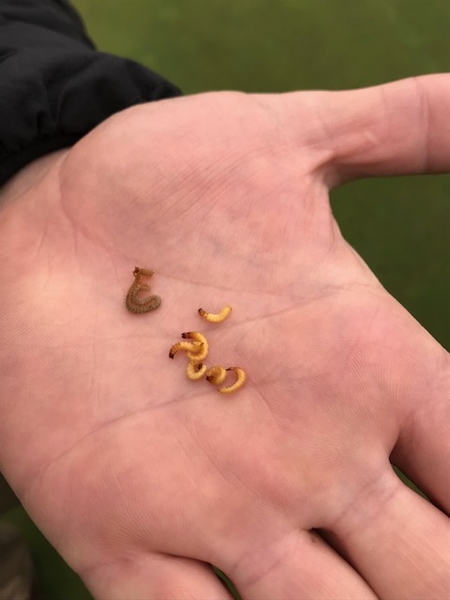
Wireworms are worm-like larvae of click beetles (Elateridae). Larvae have a shiny and hardened appearance and can range in color from tan to dark brown, although they are generally slightly darker at both the anterior (head) and posterior ends (Figure 1). They range in length from 1/3 to 1/2 in and have three pairs of legs. The final segment at the posterior end can be forked on larger larvae. Adult click beetles are elongate, slender beetles with a tapered posterior end. Adults can range in size and color but have a shield-like structure (pronotum) the back corners of which stretch back into points. When placed on their backs, these beetles snap their thoracic segments which causes their bodies to flip up in the air in an effort to right themselves. This behavior produces a characteristic "click" noise.
Biology
Adults and larvae overwinter in the soil and emerge in early to mid-spring. They are generally active through the end of summer in NC. Females dig burrows around the base of plants and lay eggs that hatch within 2-4 weeks. Larvae can remain in that life stage for up to 3-4 years, depending on species. Generations will overlap throughout the year so it is possible to find all four life stages (egg, larva, pupa and adult) at one time in the soil.
Damage
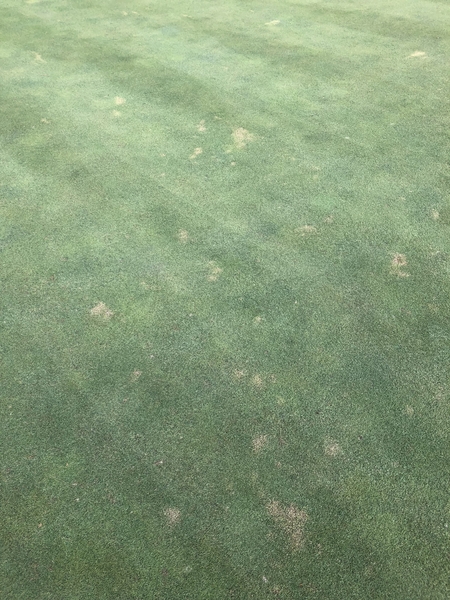
Only wireworms (larvae) are pests of turfgrass, the adults do not cause damage. Wireworms feed on the roots and crowns of plants, causing irregular patches of yellowing (Figure 2), stunted growth, and necrosis. Damage is most evident in the fall but can occur at any time insects are active. Wireworms will also feed on seeds and seedlings so newly-seeded stands are more likely to show damage symptoms.
Monitoring
Soil sampling: Use either a cup cutter, shovel or sod cutter to sample a fixed area of turfgrass. If using a cup cutter or shovel, slowly break apart the soil, and examine the lower 1-3 inches (2.5-7.6 centimeters) for wireworms. If using a sod cutter, roll back the turf like a mat. Slowly rake through the soil and examine for insects. If possible, time your sampling to follow a rainfall event as wireworms are likely to be closer to the soil surface.
Control
Cultural Control
Healthy turfgrass is less likely to show symptoms of damage. Fertilize, irrigate and conduct regular soil analysis testing to minimize plant stress and maintain a healthy turf stand.
Chemical Control
Many products used for wireworm control are restricted-use and intended for agricultural use only. Active ingredients that can be used for wireworm control in home lawns include: bifenthrin, pyrethrins, and zeta-cypermethrin. Be sure to apply insecticides when the wireworms (larval life stage) are present in the soil.
This Extension publication can also be viewed at: https://content.ces.ncsu.edu/wireworms-in-turf